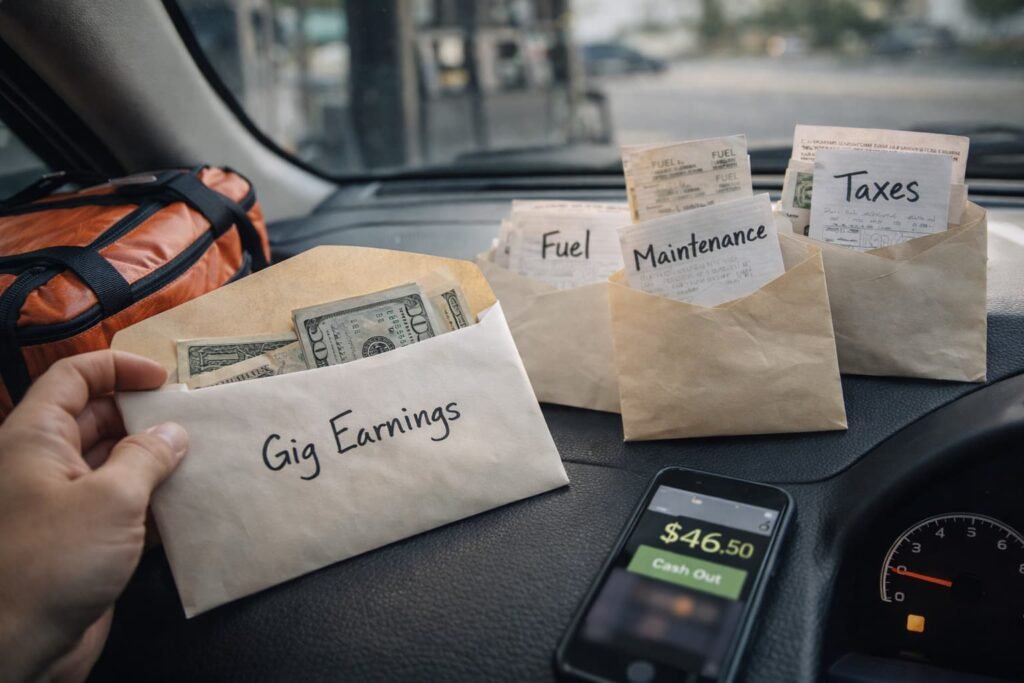

The app says $25 an hour.
Your bank account tells a different story.
That gap between what gig platforms advertise and what actually lands in your pocket is where most beginners get blindsided. On paper, gig work looks simple: open an app, accept a task, get paid. But in real life there are quiet costs — financial, time, and even emotional — that rarely show up on the earnings screen.
None of this means gig work is bad. It just means the math is more complicated than the apps make it look.
If you understand those hidden costs of gig work before you start, gig work can be a smart, flexible way to earn. If you don’t, it can feel like you’re running on a treadmill that never really moves forward.
Let’s talk about the parts nobody advertises.
1. The Financial Costs You Don’t See Upfront
Fuel and Mileage
That $18 delivery or $22 shift doesn’t include the gas you burned getting there. Short trips add up fast, and stop-and-go driving is rough on fuel efficiency. What looks like a decent payout can quietly shrink after a few refuels.
Vehicle Wear and Tear
Tires, brakes, oil changes, and general maintenance happen faster when your car becomes part of your income. Gig apps don’t cover that. You do.
Insurance Gaps
Standard car insurance often doesn’t fully cover commercial use. Many people don’t realize they may need additional coverage until something goes wrong.
Platform Fees and Cashout Charges
Some apps take a cut before you ever see the money. Others charge for instant payouts. A few dollars here and there can erase a surprising chunk of your weekly earnings.
Taxes
This one catches almost everyone. As an independent contractor, no one is withholding taxes for you. That “extra” money isn’t all yours — part of it belongs to future you, the one paying the tax bill.
2. The Time Costs Nobody Counts
Unpaid Waiting
The app only counts the minutes you’re “on task.” It doesn’t count the 15 minutes you waited for the next order or the drive back to a busy area.
Travel Between Gigs
A $12 task across town isn’t really $12 when it takes 20 minutes to get there and 20 minutes to get back.
Cancellations and No-Shows
You can plan your day perfectly and still lose an hour because a customer cancels or a shift disappears. The platform rarely compensates for that lost time.
App Glitches
Offers that don’t track, addresses that change, payments that need to be disputed — all of it costs minutes you never get paid for.
Time is the most invisible expense in gig work, and it’s often the biggest.
3. The Human Costs We Don’t Admit
Physical Fatigue
Long hours on your feet, lifting furniture, or driving all day takes a toll. Gig work can look flexible but still be physically demanding.
Mental Load
Constantly checking apps, hunting for the next task, worrying about ratings — that background stress adds up.
Unpredictable Routines
One week feels great, the next feels empty. That rollercoaster can mess with motivation and planning.
These aren’t deal-breakers, but they’re real. Pretending they don’t exist is how burnout sneaks in.
4. Why the Numbers on the Screen Can Be Misleading
When an app says “earn up to $30/hour,” it usually means:
- During peak demand
- Before expenses
- Without counting downtime
- For top-rated workers
- In the best locations
Most beginners experience something closer to:
Advertised rate – expenses – downtime = real take-home
Understanding that formula early changes everything. You stop chasing every notification and start thinking like a small business owner instead of an employee.
╰┈➤ Also Read: Best Gig Economy Side Hustles (Flexible Local Gigs That Actually Pay)
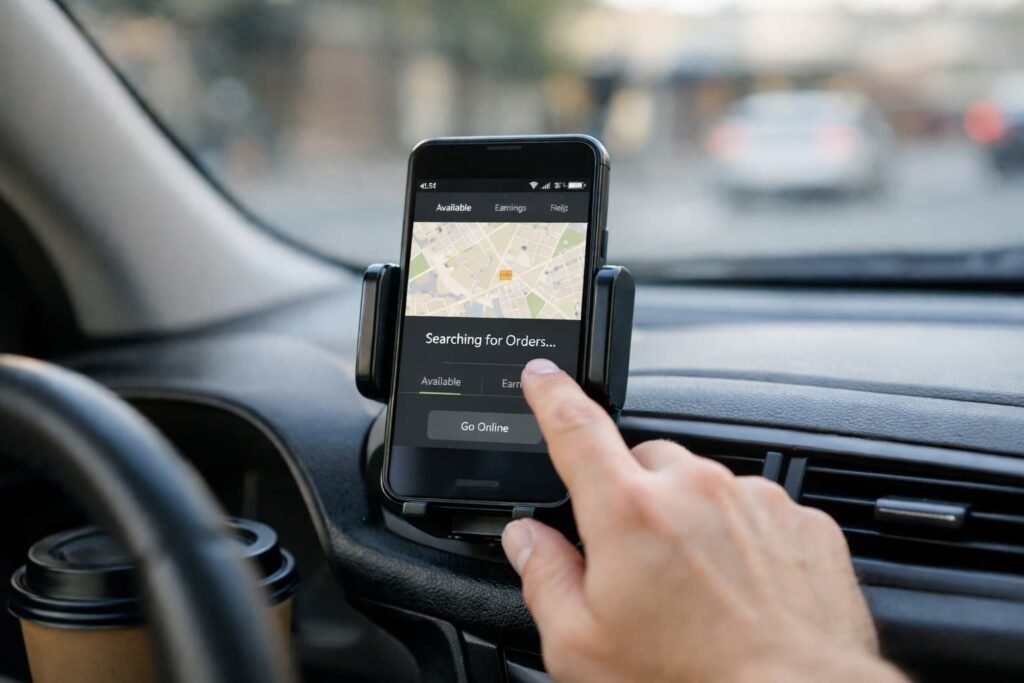
How to Reduce These Hidden Costs of Gig Work
The goal isn’t to quit gig work. It’s to do it smarter.
Be Selective
Not every task is worth accepting. Set a personal minimum based on distance and time, not just the payout.
Multi-App Strategically
Relying on one platform leaves you stuck when it’s slow. Rotating between two or three apps reduces unpaid downtime.
Track Everything
Fuel, mileage, fees, waiting time — write it down. The numbers tell you which gigs actually make sense.
Work Peak Windows
Two focused hours during high demand often beats six random hours chasing scraps.
Protect Your Vehicle
Regular maintenance is part of the job. Treat it like an investment, not an afterthought.
Save for Taxes From Day One
Pretend a portion of every payout isn’t yours. Future you will be grateful.
When Gig Work Makes Sense
Even with all these costs, gig work can be genuinely useful.
It works well if you:
- Need flexible, short-term income
- Want control over your schedule
- Prefer task-based work to fixed shifts
- Use it as a supplement, not a lifeline
It struggles when you:
- Need guaranteed pay
- Can’t absorb slow weeks
- Depend on one app only
- Ignore expenses
The difference isn’t the platform — it’s the approach.
Final Thoughts: Hidden Costs of Gig Work
Gig work isn’t a scam.
It just isn’t as simple as the ads make it look.
Behind every payout are costs the apps don’t mention — fuel, maintenance, waiting time, taxes, and the human effort of showing up day after day. Ignoring those costs is how people end a month exhausted and confused about where the money went.
But when you see the full picture, gig work can still be powerful. Not as a fantasy of easy money, but as a flexible tool you control.
Know the hidden costs. Plan for them.
And gig work becomes what it was meant to be — extra income on your terms, not a trap disguised as freedom.