

Most beginners don’t get stuck on what to sell. They get stuck on something more basic:
“Where do I even sell this?”
And the second you start researching, it turns into a maze. One person swears Etsy is the only way. Another says marketplaces are a trap. Someone else says you need Shopify from day one. Suddenly you’ve got six tabs open, comparing fees you don’t fully understand, and you’re more confused than when you started.
Here’s the clean way to think about it in 2026: there are two paths to selling digital products.
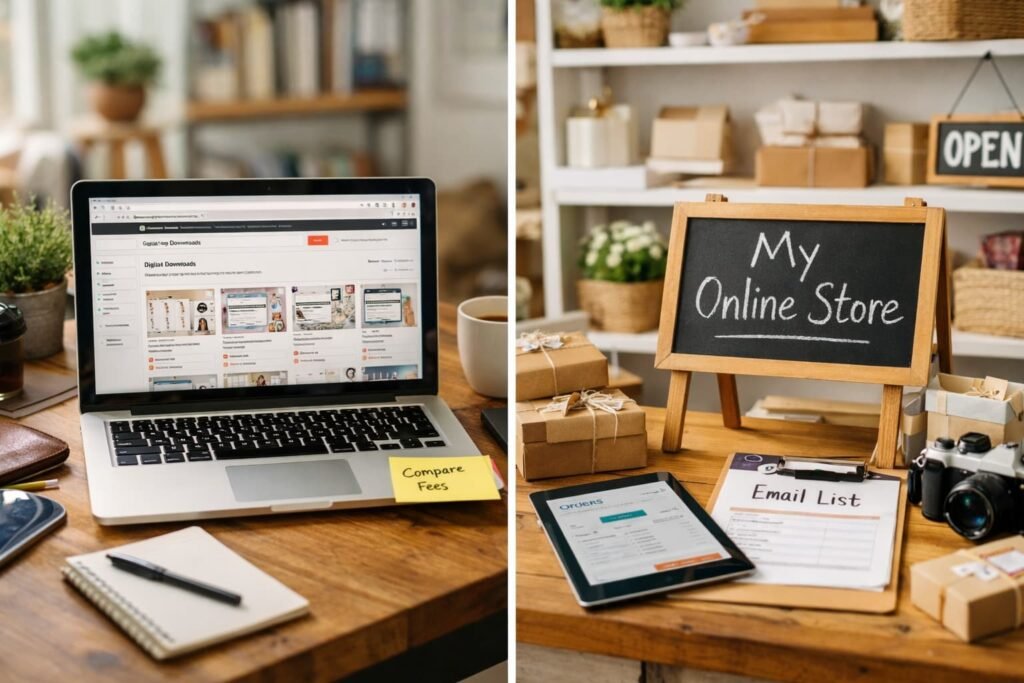
You can sell on a marketplace (where customers are already browsing), or you can sell through your own store (where you control the shop and bring the traffic).
Both options are “better” in general. The right choice depends on how you plan to get customers, how much control you want, and how much energy you can realistically put into promotion.
If you’re starting from zero and you want a chance at organic discovery, start with an online marketplace.
If you already have a way to send people somewhere (blog, social account, email list), start with an online storefront.
If you want the most realistic long-term setup, do both: an online marketplace for discovery, and an online storefront for repeat buyers and bundles.
Online Marketplace vs your Online storefront
Online Marketplace
An online marketplace is like renting a table in a busy market. People are already walking around looking for things. You don’t need an audience to get discovered because the marketplace already has search traffic and buying intent.
The tradeoff is control. You’re building on rented land:
• You follow the platform rules and policies.
• The platform controls search rankings and visibility.
• Fees can come in layers.
• Your storefront lives on their platform, not yours.
For beginners, a marketplace is often the fastest way to validate demand and get your first sales without an audience.
Online storefront
An online storefront is like opening your own shop. You control the branding, the customer experience, what you sell, how you bundle, and how you price. You can also build a customer list and bring people back—something online marketplaces don’t make easy.
The tradeoff is traffic. A store doesn’t come with built-in browsers. People won’t “stumble” into your Payhip or Gumroad page unless you lead them there through a blog, social media, Pinterest, YouTube, email, or partnerships.
The quick rule that makes this decision easier
An online marketplace helps you get discovered. Your online storefront helps you build an asset.
Online marketplaces are great for early momentum and proof of demand. Your online storefront is great for long-term growth, repeat buyers, and control. Many sellers eventually use both.
A quick note on fees (so you don’t overthink them)
Fees matter—but they’re rarely the deciding factor.
Online marketplaces often charge a mix of listing fees, transaction fees, and payment processing. Your online storefront usually has payment processing fees, plus either a monthly subscription or a platform fee.
Here’s the key: paying slightly higher fees can be worth it if the platform brings you customers. A “cheap” platform with no traffic can cost you more in time and frustration.
Online Marketplaces to Sell Digital Products: Best Options in 2026
Marketplaces shine when you want discovery, and you’re selling products people already search for (templates, printables, planners, downloads, assets).
Etsy
Best for printables, planners, templates, invitations, trackers, checklists. Etsy can be one of the clearest places to test demand because buyers are already searching. The catch is competition and multiple fee types. Treat Etsy like a search engine: titles, keywords, and clear previews matter.
Creative Market / Creative Fabrica
Best for design-heavy products (Canva templates, branding kits, graphics, icons, fonts). Buyers come looking for creative assets, so quality and presentation matter.
Envato
Best for higher-production creative assets (templates, video/motion assets, web/theme-related files). It’s not always the easiest starting point, but it’s strong if your product matches the ecosystem.
Notion Marketplace
Best for Notion templates and systems. Practical, outcome-focused templates (“organize my job search,” “track my budget,” “manage my workflow”) tend to resonate more than purely aesthetic dashboards.
Teachers Pay Teachers
Best for educational resources (worksheets, lesson plans, classroom activities). The advantage is simple: teachers already shop there.
Amazon KDP
Best for: ebooks and workbooks. If your product is a guide, workbook, or short nonfiction that solves a clear problem, KDP gives wide reach.
Udemy
Best for video courses. It’s a marketplace model—good for reach, but you trade away some pricing control and customer ownership.
Online Storefront to Sell Digital Products: Best options in 2026
Your own store shines when you want control, bundles/upsells, repeat customers, and a list you own.
Gumroad
Simple setup, fast selling, great if you already have traffic from a blog, social, YouTube, or email. Treat it like a storefront: your results improve when you bring your own customers.
Payhip
Beginner-friendly store for digital downloads and bundles. A solid pick if you want a clean storefront without a heavy tech setup.
Ko‑fi Shop
Lightweight option if your audience is already on social and you want a simple ‘link-in-bio’ shop. Great for small catalogs and simple downloads.
Shopify
Best for people who want a serious store foundation that can scale. More powerful than most beginners need on day one, but strong long-term.
WooCommerce (WordPress)
Best for people who want ownership and customization, especially if you already run a WordPress blog. More control, but more setup responsibility.
Squarespace
Best for website-first sellers who want a clean brand presence with digital products integrated into a polished site.
Podia / Sellfy (all-in-one options)
Best for creators who want one dashboard for downloads + courses + memberships (and sometimes email). Useful if you prefer simplicity over piecing tools together.
╰┈➤ Also Read: Low-Effort Digital Product Ideas for 9-5 Workers
What beginners usually get wrong
Let me save you some pain. Most beginners fall into one of these traps:
• Choosing a platform before deciding your product format (printables vs templates vs spreadsheets vs ebooks vs courses vs assets).
• Overthinking fees and underthinking traffic.
• Starting a store with no plan to get visitors (it feels like shouting into a quiet room).
A Simple Decision Framework for Where to Sell Digital Products
Choose a marketplace first if you want discovery and you don’t have an audience yet.
Choose your own store first if you already have a way to send people somewhere (even modest blog traffic counts).
Use both if you want the best long-term setup: marketplace discovery + store ownership.
A very common smart path is: marketplace for discovery → store for repeat buyers and bundles.
How AI changes this choice for Where to Sell Digital Products in 2026
AI has made it easier for people to create digital products quickly, which makes marketplaces louder and more crowded. Buyers are more cautious, and low-quality products don’t hold attention.
This pushes the market toward clearer positioning, better instructions, and stronger trust signals (good previews, honest listings, reviews over time).
So the ‘best platform’ isn’t just about fees—it’s about where your product can be understood quickly and trusted.
Final Thoughts on Where to Sell Digital Products
You don’t need the perfect platform to start. You need a platform that matches how you plan to get customers.
If you’re starting from zero, online marketplaces can help you get discovered and validate demand. If you want long-term control and repeat buyers, your own storefront becomes more valuable over time.
And if you want the most realistic path: start where buyers already are, then build a home base you own.