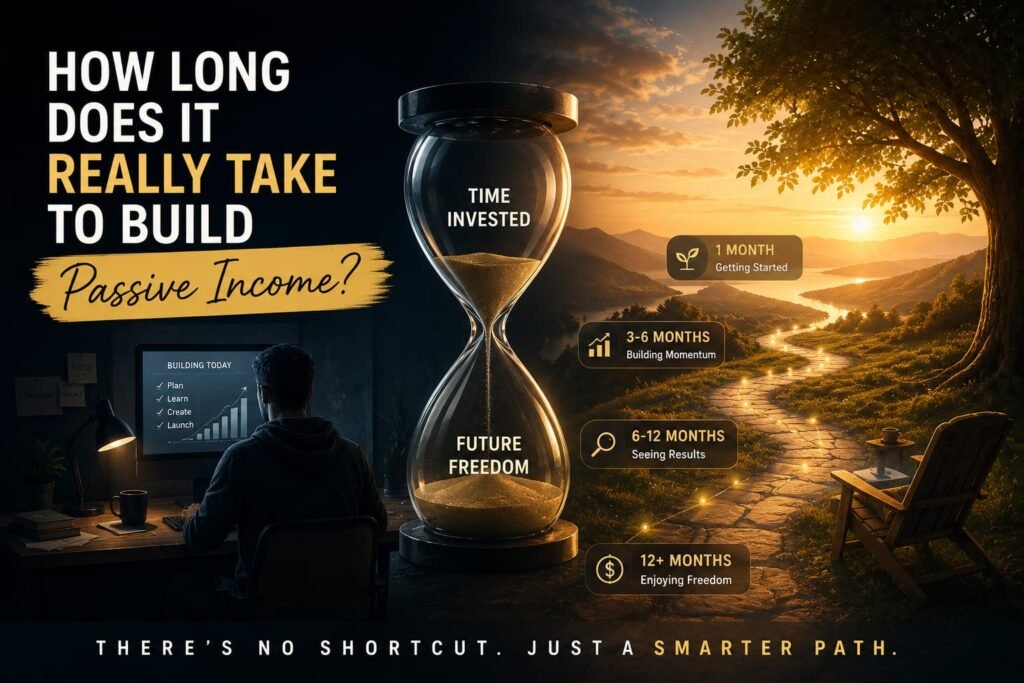

There is a specific moment that most people building passive income experience somewhere between week six and month three. The effort has been consistent. Articles have been written, designs uploaded, products listed, images submitted. The income is negligible. In many cases it is exactly zero. The gap between the effort going in and the returns coming out feels not just discouraging but genuinely confusing.
This is the moment most passive income attempts end. Not because the model is broken. Not because the person is doing something fundamentally wrong. But because nobody gave them an honest timeline before they started. As a result, they have no way of knowing whether the silence from their income dashboard signals failure or simply confirms they are exactly where they are supposed to be at this stage.
In almost every case it is the latter. The slow early phase is not a warning. It is the most predictable and universal feature of every passive income journey regardless of which stream is being built. This article gives you the timeline that should have been available before you started — stream by stream, phase by phase, with honest ranges based on how these models actually behave for typical beginners rather than the exceptional cases that get shared most loudly.
Why Nobody Gives You a Straight Answer on Timelines
Before filling this gap it is worth understanding why it exists. Honest passive income timelines are rare in the content space and the reasons are deliberate rather than accidental.
Success stories dominate because they are disproportionately shareable. The person who earned their first hundred dollars in week two generates a compelling story. In contrast, the person who earned their first hundred dollars in month seven after quiet, consistent effort represents what most people experience far more accurately — but that story is far less useful for building an audience or promoting a course. Content creators and platforms have structural incentives toward optimism that do not serve the person making a genuine planning decision.
The Incentive Problem
Genuine variation between individuals also serves as cover for avoiding specifics entirely. Timelines do vary depending on niche selection, existing audience size, quality of execution, and available hours per week. That variation is real. However, it does not justify replacing honest ranges with a vague statement that results depend on effort. Ranges can be given. Most content simply chooses not to give them because narrower claims are riskier for creators building their own reputation.
Commercial incentives compound the problem further. The platforms, tools and affiliate programmes that populate passive income content benefit financially from optimistic framing. A realistic timeline that begins with several months of minimal income makes a harder argument for a monthly subscription tool or a paid course than one that implies faster returns. Consequently, the incentives across the passive income content ecosystem work against giving you an accurate picture before you invest your time.
This article gives honest ranges based on how passive income streams actually behave for typical beginners working three to five hours per week alongside a full time job. Not exceptional early results. Not worst-case outcomes. Typical, consistent, realistic progress from someone building in the margins of an employed schedule.
The Three Phases Every Passive Income Stream Goes Through
Every passive income model — regardless of which stream you have chosen — follows the same underlying three-phase structure. Understanding which phase you are currently in changes how the experience feels because it replaces confusion with context.
Phase One: The Build Phase
The build phase is the period of active, largely unrewarded effort during which you construct the income asset. Output goes in. Revenue does not yet come out. This is entirely expected — the work you do during this phase does not produce immediate returns. Instead, it creates the foundation that all future passive income sits on.
This phase feels most uncomfortable because the effort-to-reward ratio is at its worst and income metrics show essentially zero. The natural response is to conclude that the approach is not working. In most cases, however, that conclusion is simply premature. The build phase has a minimum duration for each stream and the only way through it is through it.
Phase Two: The Traction Phase
The traction phase begins when the asset produces its first small but genuine returns. Not enough to feel significant relative to the months of effort that preceded them. Not enough to generate much enthusiasm from the outside. But enough to confirm that the underlying model functions and the direction is correct.
This phase is the most psychologically critical in the entire passive income journey. It is where most people who will eventually quit do so — not in the build phase when expectations are fresh, and not in the passive phase when income is established, but in this uncomfortable middle ground where returns are real but still feel disproportionately small.
The traction phase is where passive income attempts fail most commonly. The small and inconsistent early returns feel like confirmation that the effort is not working, when they are actually the earliest visible evidence that it is beginning to work. Recognising this phase for what it is — a transition rather than a ceiling — is the primary differentiator between builders who eventually reach passive income and those who do not.
Phase Three: The Passive Phase
The passive phase is when income becomes genuinely independent of active effort. The asset runs without requiring your regular attention. Monthly income grows slowly through the compounding effect of accumulated assets — more articles ranking, more designs listed, more images downloaded, more students enrolled. This is the phase the concept promises and the one that only becomes accessible by passing through both previous phases.
The passive phase does not mean zero work indefinitely. Rather, the effort shifts from building to maintaining — and that maintenance is a fraction of what the build phase required. A few hours per month rather than several hours per week. The income continues while the active demand on your time reduces significantly.
Stream by Stream: The Honest Timelines
The following breakdowns apply the three-phase framework to each major passive income stream. The ranges reflect consistent effort from a 9-5 worker dedicating three to five hours per week — not full-time focus and not occasional effort. Consistent, weekly commitment sustained through all three phases.
Digital Products
Digital products carry among the shortest timelines of any passive income stream, which is a primary reason they suit 9-5 workers well as a starting point. The build phase for a first product — an ebook, a Canva template pack, a printable set — typically spans two to eight weeks depending on complexity and your familiarity with the creation tools.
Traction begins when the product is listed and the first buyers find it. For a well-positioned product with basic promotion — sharing it in relevant communities, optimising the listing for searchability, linking to it from any existing content — first sales typically appear between weeks two and six after listing. By months three to six, a product with some early reviews and platform visibility earns consistent monthly sales with little to no active promotion required per sale.
The passive phase arrives fully by months six to nine for a single product. A catalogue of three or more complementary products reaches genuine passivity faster because each product refers buyers to the others and the combined platform visibility compounds more quickly than any single listing. For a clear overview of which digital products are worth building first, the guide on digital products to create once and sell forever covers the strongest options in detail.
Affiliate Content
Affiliate content carries a longer build-to-traction timeline than digital products because the income depends on search engine visibility, which has its own timeline regardless of content quality. The first three months of publishing are almost entirely a build phase with minimal traction — not because the content is failing but because search engines need time to crawl, index, and rank new content.
First meaningful affiliate commissions typically appear between months two and four for well-optimised content targeting specific search terms with genuine affiliate recommendations naturally embedded. Moreover, consistent monthly commissions — the point at which affiliate income feels reliable rather than occasional — arrive between months six and nine for publishers maintaining a steady output of quality content. The full picture of how affiliate content works for someone with a full-time job is in the guide on affiliate marketing for 9-5 workers.
The passive phase for affiliate content is perhaps the most durable of any stream on this list. An article that took three hours to write and optimise in month two can still generate commissions in year four if the topic remains relevant and the content holds its ranking. Furthermore, individual articles can take six to eighteen months to reach their ranking ceiling. Once there, they earn without further attention until the topic itself becomes obsolete.
Stock Photography
Stock photography has a build phase driven almost entirely by portfolio volume. The first three to four months go toward learning platform requirements, developing an efficient shooting, editing and keywording workflow, and building the submission depth needed for consistent downloads to begin. The income during this period is negligible regardless of the quality of individual images — because a small portfolio simply does not generate enough search appearances for consistent download volume.
Regular downloads begin when the portfolio reaches approximately 100 to 150 submitted images positioned in commercial niches with strong keywords. Consistent monthly income arrives around the 200 to 300 image mark for most contributors working in focused subject areas. The passive phase — where the portfolio earns consistently with only light monthly maintenance — arrives at 500 or more targeted images, typically eight to twelve months after starting. For a realistic look at what stock photography actually earns, the breakdown on stock photos as passive income covers the honest numbers.
Print on Demand
Print on demand follows a similar trajectory to stock photography in that catalogue depth is the primary income driver. The first three to four months form a build phase focused on reaching the design volume needed for consistent buyer discovery. Individual sales can appear earlier — some contributors make their first sale within weeks of their first upload — but consistent monthly income that compounds reliably requires 50 to 80 niche-specific designs for most contributors.
The traction phase brings irregular sales that are real but unpredictable. Consistent monthly income arrives between months four and seven for contributors building toward 100 targeted designs. The passive phase — where the catalogue earns with minimal ongoing attention — typically arrives between months seven and ten for focused builders.
YouTube
YouTube carries the longest build phase of any stream covered here and that gap deserves stating plainly before anything else. The period between publishing a first video and reaching the YouTube Partner Programme threshold of 1,000 subscribers and 4,000 watch hours typically spans six to eighteen months of consistent publishing for a channel in a focused niche. During that entire period, ad revenue is zero. Not minimal — zero.
The traction phase begins after Partner Programme approval, when ad revenue accumulates from video views and affiliate link clicks in descriptions begin converting. Consistent monthly income that compounds meaningfully arrives between months fourteen and twenty for most focused channels. The passive phase — where the existing video library earns from accumulated views without requiring frequent new uploads — arrives around months eighteen to twenty-four. For a direct comparison of YouTube against other income routes, the article on blogging or YouTube for 9-to-5 workers lays out the trade-offs clearly.
YouTube belongs on this list despite its timeline because the ceiling and durability are both exceptional. Every video published becomes a permanent earning asset that compounds as the library grows. A focused channel that reaches the passive phase can eventually generate more monthly income than several shorter-runway streams combined.
Online Courses and Mini Workshops
Online courses and mini workshops have a compressed timeline compared to every other stream here because the income does not depend on search engine ranking or platform algorithm discovery. The product sells directly — through an email list, a social audience, a community, or word of mouth — which means first revenue can appear within days of launch for a creator with even a modest existing audience.
For creators building from zero, the timeline extends to two to four months as promotion and organic discovery build. Consistent monthly enrolments arrive by months three to five for a well-positioned course with a clear transformation promise and a basic ongoing promotion strategy. The passive phase arrives by months five to eight when the course accumulates enough reviews and search visibility to attract new students without active promotion every month.
The table below summarises all six timelines for quick reference:
| Stream | First Traction | Consistent Monthly Income | Genuine Passive Phase |
| Digital Products | Weeks 2 – 6 | Months 3 – 6 | Months 6 – 9 |
| Affiliate Content | Months 2 – 4 | Months 6 – 9 | Months 9 – 12 |
| Stock Photography | Months 3 – 4 | Months 5 – 8 | Months 8 – 12 |
| Print on Demand | Months 2 – 4 | Months 4 – 7 | Months 7 – 10 |
| YouTube | Months 12 – 18 | Months 14 – 20 | Months 18 – 24 |
| Online Courses | Weeks 2 – 8 | Months 3 – 5 | Months 5 – 8 |
All ranges assume consistent weekly effort throughout. Inconsistent effort extends every timeline. Strong niche specificity and an existing audience of any size compress them.
What Makes Timelines Shorter or Longer
The ranges above reflect average progress. Four variables determine where any individual lands within those ranges — and whether they fall at the faster or slower end.
Existing audience
An existing audience is the single most powerful timeline compressor across every passive income stream. Someone who already has 500 engaged email subscribers, a modest social media following, or an active blog readership can compress the traction phase by months on almost any new stream they launch. The reason is simple: the first buyers, viewers or downloaders are always the hardest to reach from zero. If they already exist and trust the source, the discovery problem that extends early timelines is partially solved before the new stream even launches.
Niche specificity
Broad and competitive niches extend timelines because the existing content, products and imagery in those spaces is already deep and well-established. For example, a new blog targeting general productivity advice competes with thousands of well-ranked existing articles. In contrast, a new blog targeting productivity strategies specifically for shift workers in healthcare enters a far less crowded space. Therefore, niche specificity is not a compromise or a limitation — it is the strategic choice that most directly accelerates traction for anyone building from a small starting point.
Consistency of effort
The timelines above assume consistent weekly effort throughout the build phase. Algorithms and platforms reward consistent signals of activity and penalise gaps. A blog that publishes one article every ten days gains search momentum more reliably than one that publishes five articles in a week and then goes silent for a month. Similarly, a stock portfolio that grows by five images weekly builds platform visibility more steadily than one that adds fifty images in a burst followed by a two-month pause. In compounding models, consistency of pace beats intensity of effort almost every time.
Quality of execution
A well-researched and properly structured article outranks a thin one regardless of when it was published. A digital product that solves a specific problem completely outsells a broader, shallower product in the same category. A stock image with strong, accurate keywords gets downloaded when a technically identical image with weak metadata does not. Quality does not guarantee speed but consistently poor execution reliably predicts extended timelines. The baseline for each stream is real quality — not perfection, but genuine usefulness to the intended buyer or reader.
The builder who consistently produces quality work in a specific niche at a sustainable weekly pace will reach the passive phase faster than the builder who chases volume, jumps between strategies, or treats the build phase as optional. The model rewards patience and specificity above almost every other combination of qualities.
How to Measure Progress When Income Is Not Yet the Right Metric
During the build phase and the early traction phase, income is a lagging indicator. It reflects decisions and effort from weeks or months ago rather than what is happening right now. Using it as the primary measure of whether a passive income stream is working leads to premature conclusions because the feedback loop operates on a timeline that does not match the pace of the work.
Instead, what you need during the build phase are leading indicators — observable signals that tell you whether the right progress is happening before it shows up as income. The table below maps leading indicators to each major stream:
| Stream | Leading Indicators to Track |
| Affiliate content / Blog | Google indexing, organic traffic growth, affiliate link clicks, time on page |
| Digital products | Product page visits, wishlists or saves, search appearance for target keywords |
| Stock photography | Submission approval rate, appearance in platform search, download frequency |
| Print on Demand | Listing views, niche search appearance, favourites or saves on designs |
| YouTube | Watch time growth, subscriber rate, click-through rate on thumbnails |
| Online courses | Landing page visits, email list sign-ups, early enrolment conversions |
These leading indicators are not consolation prizes or alternative ways of feeling good about slow results. They are the genuine signals that the asset moves toward income. A blog that Google indexes, attracts growing organic traffic month over month, and generates affiliate link clicks will produce commissions. The income has not appeared yet because the compounding process takes time — not because the process is broken.
The most useful shift during the build phase: stop measuring whether you are earning and start measuring whether the asset is growing. A consistently growing asset will eventually earn. The model determines the timeline. Your role is to keep building until the asset reaches the threshold where it earns independently.
Choose a single primary leading indicator for your chosen stream and track it weekly. For a blog: organic sessions from Google Search Console. For a digital product: listing views or saves. For stock photography: weekly download count or approval rate. For print on demand: listing impressions in niche searches. A metric that trends upward week over week — even incrementally — means a passive income asset is under active construction. That is precisely what the build phase is supposed to look like.
The Timeline Is the Strategy
The slow early phase of passive income is not a problem to solve or a delay to shorten through some technique not yet discovered. It is the model working as designed. Every article published, every design uploaded, every image submitted, every product listed is a permanent addition to a compounding asset. The income that does not appear in month one appears in month six. The income that does not appear in month six appears in month twelve. The compounding is real — it simply operates on a timeline that requires the builder to stay present through the stretch that does not yet feel like progress.
The 9-5 worker has a genuine structural advantage here that deserves acknowledging. You are not dependent on the passive income to cover next month’s expenses. The salary handles that. As a result, the passive income builds in parallel, in the hours that exist alongside an employed schedule that already works. That financial stability means the build phase can proceed at its correct pace without the distortion that financial pressure would impose on every decision along the way.
Where You Most Likely Stand Right Now
The timelines in this article are honest averages for consistent builders. If you are currently somewhere in the build or early traction phase of any stream covered here, the most likely interpretation of your experience is straightforward: you are exactly where you are supposed to be, building an asset whose returns are not yet visible but are accumulating in ways the leading indicators will confirm if you look for them.
If you are still choosing your stream, the complete overview of every passive income option worth considering for a 9-5 worker — with an honest assessment of what each one requires — is available in the guide on digital products built for repeatable income. For a broader view of what earning from a blog actually requires week to week without daily posting, the article on how to earn from a blog without posting every day is the most practical companion to this one. Choose one stream, commit to the timeline it honestly needs, and measure the right things while you build.