
This article offers general information on tracking side hustle income, not tax or accounting advice. Tax rules differ by country and situation — for the actual rules where you live, see the local side hustle guides on this blog and your national tax authority, and consult a qualified professional once your earnings are substantial.
Picture the version of you who did not track anything. It is tax season, your side hustle made real money over the year, and you are scrolling back through a single bank account where side hustle payments, your salary, groceries and a hundred personal transactions are all mixed together. You are trying to reconstruct what you actually earned and what you spent to earn it. It takes a frustrating weekend, the numbers are guesses, and you have no idea whether you have set aside enough for tax. This article is about never being that person.
The good news is that to track side hustle income properly you do not need an accountant, accounting knowledge, or any paid software when you are starting out. It requires a simple system and the small habit of keeping it updated. Set that up early and the weekend of panic never happens. You know what you earned, what you spent, and what you owe, at any moment. Here is the whole system, and it works whatever country you are in.
Start With One Move: Separate the Money
Before any spreadsheet or app, do the single thing that makes everything else easy: open a separate bank account for your side hustle and run all of it through there. Side hustle income comes in, side hustle expenses go out, and nothing personal touches it. Many banks offer free second accounts, and a basic one is enough.
This one move solves most of the tracking problem before it starts. When your side hustle money lives in its own account, you no longer have to disentangle business from personal at tax time. The account statement is already a record of your side hustle and nothing else. It makes your income obvious, your expenses clear, and any future tax filing dramatically simpler. People who skip this step create the mixed-transaction nightmare from the opening. People who do it have already won half the battle. If you do only one thing from this article, do this.
A separate account is also the foundation of the set-aside habit covered later. Some side hustlers go a step further and open two: one that all income and spending flows through, and a second plain savings account where they move the portion reserved for tax so it is physically separated and not accidentally spent. You do not need the second account to start, but the moment your earnings become meaningful, it is the simplest way to never be caught short at tax time.
The Tracking System Itself
With the money separated, tracking is just recording what moves through that account in a form you can total up later. You have two honest options, and the right one is whichever you will actually keep updated.
A Simple Spreadsheet
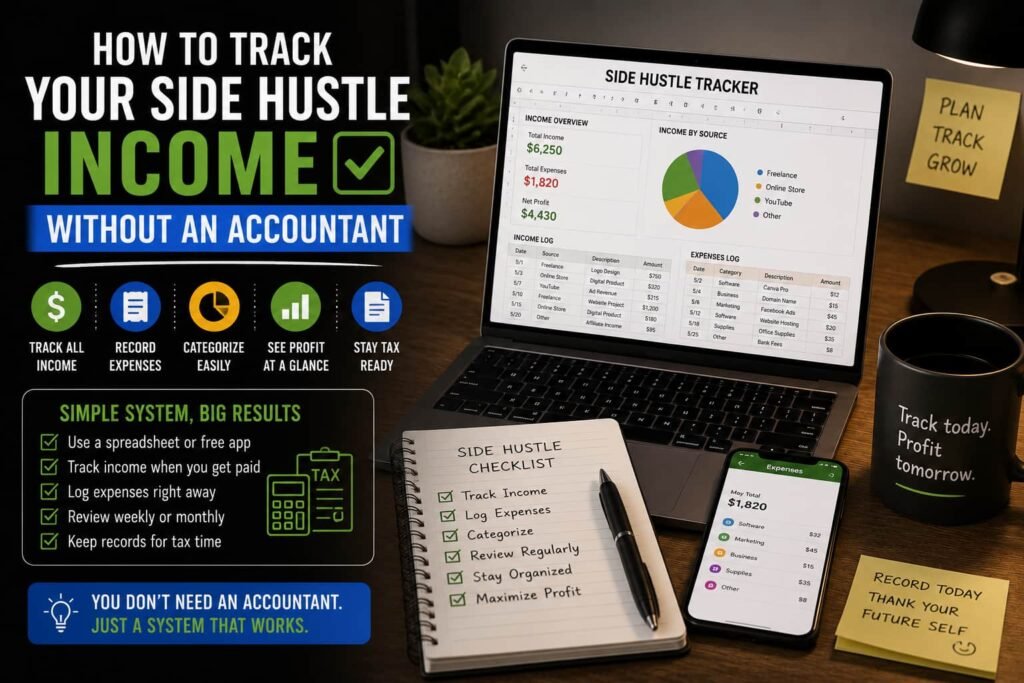
For most people starting out, a basic spreadsheet in free software like Google Sheets is genuinely all you need, and it costs nothing. Create one sheet for income and one for expenses, or a single sheet with a column that marks each row as one or the other. The columns that actually matter are few: the date, a short description of what it was, the amount, and a category. That is the core of it. For income, the category might be which client or which platform the money came from. For expenses, it might be what kind of cost it was — tools, fees, materials, travel. A running total at the bottom tells you your income, your expenses, and the difference, which is your actual profit.
The discipline that makes this work is updating it regularly in small doses rather than facing a year of transactions at once. A weekly habit of opening the sheet, glancing at the separate account, and entering the handful of new lines takes a few minutes and keeps the whole thing accurate. The system is simple on purpose, because a simple system you maintain beats a sophisticated one you abandon.
A Free App, When the Spreadsheet Creaks
When the volume of transactions grows enough that manual entry becomes a chore, a free tool is the natural step up. Wave is the standout here: it is genuinely free for income tracking, expense tracking and invoicing, it can connect to your account to import transactions automatically, and it supports multiple currencies, which matters if you earn from international clients. Moving from a spreadsheet to a tool like Wave is the right upgrade when entering rows by hand starts costing you more time than it saves — not before. The spreadsheet is rarely the thing holding a beginner back.
The honest principle behind all of this: the best tracking method is the one you will actually use. A simple spreadsheet you update every week is worth more than a powerful app you set up once and ignore. Start with whatever is simplest for you, and only add sophistication when a real need forces it.
Keep the Proof and Sort as You Go
Recording the numbers is most of the job. Keeping the evidence behind them is the rest. For income, your separate account statement and any invoices you sent are your record. For expenses, keep the receipts and invoices for anything you bought for the side hustle. A digital photo or a saved email is fine, stored in one folder so they are not scattered across your phone and inbox.
This matters for two reasons. First, in most countries you are required to be able to substantiate both the income you declare and any expenses you claim against it, and tax authorities can ask you to produce records going back several years. Second, expenses you cannot prove are expenses you may not be able to claim, which can mean paying more tax than necessary. Categorising expenses as you go — rather than facing an undifferentiated pile later — also means that when it is time to file, your spreadsheet or app already shows what you spent and on what. The habit of sorting in real time turns a year of activity into a clean, ready record instead of a reconstruction project.
Set Aside for Tax From the Start
The mistake that hurts side hustlers most is not tracking income badly. It is spending all of it and then discovering, too late, that some of it was always owed in tax. The fix is a habit, not a calculation: every time income lands, move a portion of it aside before you treat the rest as yours.
How much to set aside depends entirely on where you live and how much you earn. That is exactly the kind of jurisdiction-specific detail this article will not guess at. The local side hustle guides on this blog cover the actual rules and thresholds for the UK, Canada, South Africa and other markets, and your national tax authority is the definitive source. But the universal habit is the same everywhere: decide on a percentage to reserve, move it into the separate savings account the moment income arrives, and do not touch it. Setting aside a sensible portion of each payment as it comes in means the tax bill, whenever and whatever it is, is already covered rather than a shock.
Tracking your income is not the same as knowing your tax obligations, and this article deliberately does not cross that line, because the rules genuinely differ from one country to the next and getting them wrong has real consequences. A clean record of what you earned and spent is what makes meeting those obligations easy — but for what you actually owe, when it is due, and what you can claim, rely on your national tax authority, the relevant local guide on this blog, or a professional once your earnings justify one. The tracking system in this article is what makes that step painless; it is not a substitute for it.
A Few Minutes a Week, Not a Weekend of Panic
None of this is complicated, which is the point. A separate account, a simple sheet you update weekly, receipts kept in one folder, and a slice of every payment moved aside for tax — that is the entire system to track side hustle income properly. It requires no accountant and no accounting knowledge to run. It takes a few minutes a week and it replaces the worst weekend of the side hustler’s year with a record that is simply already done.
The side hustlers who get into trouble with their money are almost never the ones who earned too little or spent too much. They are the ones who never set up a way to see what was happening, and so found out too late. Set the system up in the first week your side hustle earns anything, keep it for a few minutes each week, and the money side of your side hustle quietly takes care of itself while you get on with the part that actually makes the money.
For the free tools worth using alongside this system, the guide on best free tools every side hustler needs covers what to set up and what to skip. And for those just getting started on a platform like Fiverr, the article on getting your first client on Fiverr covers the side hustle that makes the income worth tracking.