
This article includes general information on YouTube’s monetization requirements and policies current as of 2026, including the July 2025 policy changes. YouTube updates its rules regularly — always verify current Partner Program requirements and content policies on YouTube’s official Help pages before relying on them.
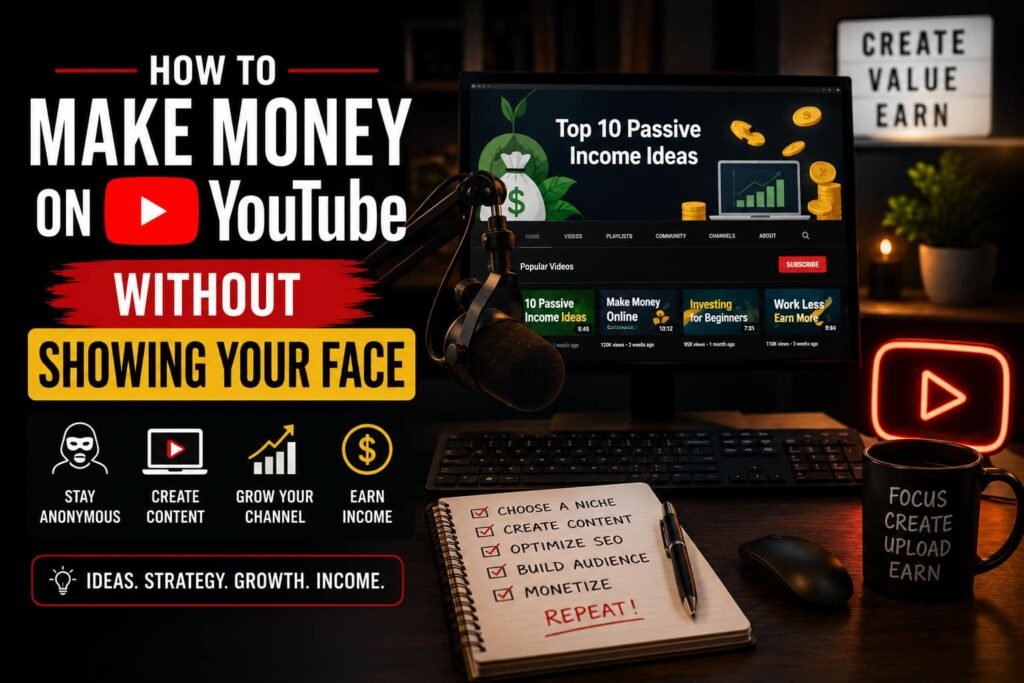
Plenty of people would happily build a YouTube channel if it did not mean putting their face on the internet. Some are simply camera-shy. Others have a specific and sensible reason. They have a full-time job where they would rather colleagues and employers not stumble across their side project. Faceless YouTube removes that barrier entirely, and it is not a workaround or a lesser version of the platform. Some of the largest channels on YouTube have never shown a face.
What faceless YouTube does not remove is the work, and this is where honesty matters more than on almost any other side hustle. YouTube is the slowest-building platform in this whole category. Industry data suggests only around 3 percent of channels ever reach monetization. It typically takes six to twelve months to get there. Many creators spend money on tools before earning any. Anyone promising fast, effortless faceless income is selling you something. This guide treats YouTube as what it actually is: a long-term asset that, built properly, can earn for years. It is also one that YouTube has recently made much harder to fake your way through.
That last point shapes everything. In 2025, YouTube drew a sharp line between faceless channels that add real value and faceless channels that are just spam. Understanding which side of that line you are on is now the difference between a channel that earns and one that never gets monetized at all.
The Line YouTube Drew: Sustainable Faceless vs Spam
In July 2025, YouTube renamed its old repetitious content policy to the inauthentic content policy and expanded its scope. The change specifically targets the wave of low-effort, mass-produced faceless channels that had flooded the platform. This is the single most important thing a new faceless creator needs to understand, because it determines whether your channel can ever earn.
The crucial clarification is that faceless is not banned, and never was. YouTube stated plainly that the update is not a crackdown on commentary channels or entirely faceless channels. Such channels are not penalized if they genuinely qualify for monetization. What the policy targets is mass-produced and repetitive content, and that distinction is everything. A faceless channel built on real value is fine. A faceless channel built on automated spam is now explicitly ineligible.
What Counts as Ineligible Now
What YouTube now explicitly considers ineligible includes AI-generated videos with minimal human input, narration laid over reused clips you did not create, and videos that simply read other material verbatim. Channels mass-producing near-identical videos on the same template are ineligible too. The high-risk profile is clear. It includes AI voiceover channels with no genuine narrative voice over generic stock footage, and compilation channels that reuse clips without real commentary. It also includes news-reader channels that read articles word for word, and Shorts farms pushing ten or more templated videos a day.
The test is simple: does a human being add genuine, original value that a viewer could not get from an automated feed? A faceless channel where you write the script and choose what to say passes that test. So does one where you narrate with a real point of view and create or meaningfully transform the visuals. A channel where software assembles stock footage under a robotic voice reading scraped text fails it. Faceless is about not showing your face — it was never meant to mean removing the human entirely. The channels that earn in 2026 keep the human and hide only the face.
Step 1: Choose a Sustainable Faceless Format
Several faceless formats genuinely work, and the right one depends on your skills and the topic you want to cover. What they share is that a real person is doing real creative work behind the scenes.
| Faceless Format | What It Is | Sustainable If… |
| Voiceover + visuals | You narrate over footage, b-roll, or graphics | The narration and selection are genuinely yours |
| Tutorial / screen-recording | Screen capture with your voice, teaching something | You teach real skills clearly |
| Animation / motion graphics | Animated explainers or stories | The writing and animation are original |
| Commentary / analysis | Your takeover clips or topics | You add real analysis, not just clips |
| Curated / list (higher risk) | Ranked or themed compilations | You add original research and narration |
Voiceover over visuals is the most common faceless format. You write and narrate a script over relevant footage, b-roll, or graphics, covering anything from history to finance to science. It works when the script and narration are genuinely yours and bring a perspective. Tutorial and screen-recording channels teach real skills through screen capture and voice. This is one of the most durable faceless models because the value is obvious and undeniable. Animation and motion graphics channels turn original writing into animated explainers or stories. Commentary and analysis channels react to or analyze topics and clips, adding the genuine insight that separates them from bare compilations.
Curated and list-style content — rankings, themed collections — sits in a higher-risk zone, because it edges toward the compilation territory YouTube targets. It can still work, but only if you add original research, genuine narration, and a real point of view rather than assembling other people’s clips. Whichever format you choose, pick a specific niche rather than a general one. A channel about personal finance for new graduates will build a clearer audience than a vague money channel. The same logic applies to a specific Etsy listing or course beating a broad one.
Step 2: Understand How Monetization Actually Works
Making money on YouTube starts with the Partner Program. In 2026 there are two tiers with different thresholds, which is useful for a new channel because the first tier is reachable sooner.
| Tier | What You Need | What It Unlocks |
| Early access | 500 subscribers, 3 public videos, 3,000 watch hours (or 3M Shorts views) in 90 days | Super Thanks, memberships, Shopping |
| Full ad revenue | 1,000 subscribers + 4,000 watch hours in 12 months (or 10M Shorts views) | Ad revenue, Premium revenue |
The early-access tier lets you apply with 500 subscribers, three public videos and 3,000 watch hours (or three million Shorts views) in the past 90 days. This unlocks fan-funding features like Super Thanks, channel memberships and Shopping. Full ad revenue still requires the long-standing threshold of 1,000 subscribers. You also need either 4,000 valid public watch hours over twelve months or ten million Shorts views. Reaching either is the slow part — it is the months of consistent uploading that the 3 percent statistic refers to.
One thing to understand about ad revenue specifically: it is paid based on RPM, the amount you earn per thousand views, and that figure varies enormously by niche. Finance, business and technology content can earn many times the RPM of entertainment or general content. Advertisers pay more to reach those audiences. Shorts also pay dramatically less per view than long-form videos. This means two channels with identical view counts can earn wildly different amounts. That is why niche choice affects income as much as audience size.
Step 3: Earn Beyond Ad Revenue
Here is something the ad-revenue focus obscures: for many faceless channels, ad revenue is not even the main income. Relying on it alone leaves money on the table and exposes you to YouTube’s RPM swings. The channels that earn well treat ad revenue as one stream among several.
The Streams Worth Building Alongside Ad Revenue
Affiliate marketing is often the largest. A faceless channel reviewing or explaining products, software or tools earns commission on purchases made through links in the description. This can dwarf ad income because a single sale pays more than thousands of ad views in many niches.
Sponsorships follow once you have an engaged audience, with brands paying directly for placements. A niche faceless channel with a defined audience is genuinely attractive to relevant sponsors. Your own products are the highest-leverage stream of all: a faceless channel is an ideal funnel to a course, an ebook, a template pack or a digital product, sending viewers to assets you fully own.
This matters especially because it reduces your dependence on the Partner Programme entirely. Affiliate income and product sales do not require monetization approval at all. That means a faceless channel can begin earning through these routes before it ever hits the ad-revenue threshold. This softens the long wait that discourages most creators. For a detailed look at building one of those owned assets, the article on best digital products to create once and sell forever covers the full range, and the guide on how to use Teachable to sell a course around your 9-5 schedule covers turning that knowledge into a product directly.
Step 4: Build It Around a Full-Time Job
Faceless YouTube fits a full-time job better than face-based channels in one important way. Because you are not on camera, the production can be batched and scheduled flexibly without needing you camera-ready. You can write scripts on a commute, record voiceovers in a quiet evening, and edit at the weekend, assembling videos in stages rather than in one sitting.
The realistic approach is consistency over intensity. A sustainable faceless channel is built by publishing genuinely good videos on a steady schedule over many months, not by burning out trying to post daily. One strong video a week, maintained for a year, beats ten videos in a fortnight followed by silence. That holds both for the algorithm and for your own stamina around a job. Use the months before monetization to improve: study which of your videos retain viewers, refine your scripting and thumbnails, and let the channel compound. Be honest with yourself about the timeline and judge early progress by watch time and retention rather than income, because the income genuinely lags the work here.
The privacy point that makes faceless attractive to a 9-5 worker comes with a practical reminder. Faceless protects your identity from viewers, but if your channel touches your employer’s industry or uses anything from your job, the usual cautions apply. Check that your employment contract permits outside content creation, keep the channel clearly separate from your work, and never use confidential material from your job. Faceless hides you from the audience — make sure the content itself does not create a conflict regardless.
The Face Is Optional. The Effort Is Not.
Faceless YouTube is one of the few side hustles where the barrier that stops most people — being on camera — turns out to be entirely optional. The barrier that actually matters is doing genuine creative work consistently over a long time. That is the one nobody can remove for you. The 2025 policy changes made that trade explicit: YouTube will happily monetize a channel that never shows a face, and will refuse one that never shows a human. The face is optional. The effort and the originality are not.
So the path is clear, even if it is not short. Choose a faceless format where you genuinely create rather than assemble, pick a specific niche, and publish good videos steadily around your job. Build income from affiliates and your own products rather than waiting only on ad revenue. Accept that it takes months and that most who quit do so before the compounding starts. Build it that way and a faceless channel becomes a real, durable asset. It earns from your work without ever requiring your face, which for a great many people is exactly the point.
For a realistic picture of how this timeline compares to other streams, the guide on how long it takes to build passive income gives honest breakdowns for each option. And for the blog-based version of the same patient-content approach, the article on how to earn from a blog without posting every day covers the parallel path in detail.