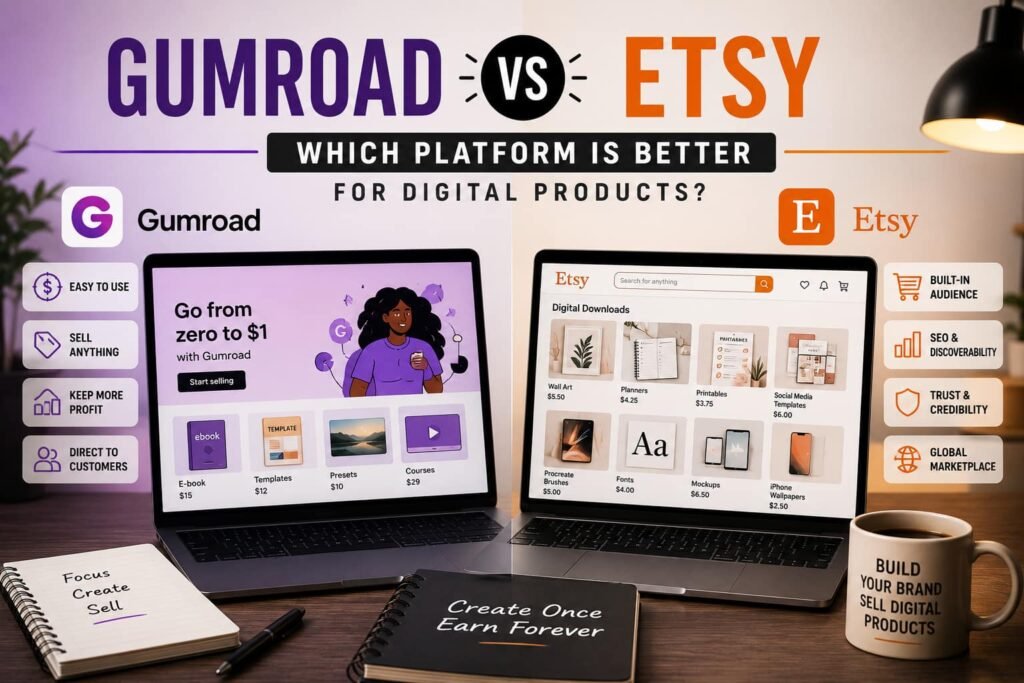

This article includes general information on Etsy and Gumroad fees current as of 2026. Both platforms change their terms and fees regularly and they vary by country — always verify current fees on each platform’s official pricing page before relying on them.
Ask which platform is better for selling digital products and the honest answer is not a name. It is a question back: how are your buyers going to find you? That single question decides almost everything in the Gumroad vs Etsy comparison, because the two platforms are built on opposite answers to it. Choosing well is less about which is better in the abstract and more about which matches how you will actually reach customers.
Both platforms genuinely work for digital products — printables, templates, planners, ebooks, design assets and the rest. Both are used by thousands of creators earning real money. But they are fundamentally different kinds of tool. Picking the wrong one for your situation means either paying for reach you do not need or expecting reach that was never there. This guide lays out the real distinction, compares them across what actually matters, and ends with a clear sense of which fits you — including the common case where the answer is both.
The One Distinction That Decides It
Etsy is a marketplace. Gumroad is a direct-sales tool. Almost every practical difference between them flows from that one fact, so it is worth being precise about what it means.
What Each Platform Actually Gives You
Etsy has its own enormous population of shoppers who come to the site to browse and search for things to buy. When you list a digital product on Etsy, you place it in front of that built-in traffic. People are already there, already shopping, and may discover your product through search without you doing anything to bring them. That discovery is the core thing Etsy provides, and it is genuinely valuable, especially when you have no audience of your own.
Gumroad provides almost the opposite. It gives you a clean, simple way to sell a digital product — a product page, a checkout, automatic file delivery, payment handling — but it sends you essentially no buyers. Nobody browses Gumroad the way they browse Etsy. If you put a product on Gumroad and do nothing else, nothing happens. Gumroad assumes you already have a way to reach people — an audience, an email list, a social following, a blog, a YouTube channel — and simply need somewhere to sell to them. It is the checkout, not the shop window.
Here is the whole decision in one line: Etsy brings you buyers but charges for the privilege and keeps the customer relationship. Gumroad charges less on a direct sale and hands you full control, but brings you no one. The question is not which platform is better. It is whether you can bring your own audience. If you can, Gumroad’s model rewards you. If you cannot yet, Etsy’s discovery is worth what it costs.
Etsy vs Gumroad, Across What Matters
| Etsy | Gumroad | |
| Type | Marketplace — buyers browse and search | Direct-sales tool — you bring the buyers |
| Discovery | Built-in — Etsy shows you to its shoppers | None — no one finds you on the platform |
| Direct-sale fees | ~10-12% effective (listing + transaction + processing) | 10% + $0.50, plus ~2.9% + $0.30 processing (~13%) |
| Marketplace fee | Offsite Ads 12-15% on ad-driven sales | 30% flat on Gumroad Discover sales |
| Audience ownership | Limited — buyers are Etsy’s customers | Full — you keep buyer emails and the relationship |
| Sales tax / VAT | Etsy handles it | Gumroad handles it as Merchant of Record |
| Best for | Searchable products, no audience yet | Sellers who can drive their own traffic |
Discovery and Traffic
This is the decisive difference. Etsy’s search puts your product in front of people actively looking for it, which means a well-optimised listing can sell with no external marketing at all. Gumroad has no meaningful browse traffic of its own for most sellers, so every sale traces back to traffic you generated. If you have an audience, that is fine — you point them to your Gumroad page. If you do not, Gumroad is a storefront on an empty street.
Fees
The headline fees are closer than people assume. Gumroad charges a flat 10% plus $0.50 on a direct sale, with card processing of roughly 2.9% plus $0.30 on top, landing around 13% on a typical sale. Etsy’s listing fee, 6.5% transaction fee and payment processing combine to roughly 10 to 12% before any ads. On a straight direct sale, the two are broadly comparable, with Etsy often slightly cheaper. The fee is not really where the decision lives — the traffic is.
Where the fees diverge sharply is on marketplace-driven sales. If a new buyer finds your product through Gumroad’s own Discover marketplace rather than your traffic, Gumroad takes a flat 30% — triple the direct rate. Etsy’s equivalent is Offsite Ads, which takes 12 to 15% on sales it generates through external advertising and becomes mandatory once you pass $10,000 in annual sales. Both platforms charge a premium when they bring you the buyer rather than you bringing them yourself. That is simply the marketplace-versus-direct distinction showing up in the pricing.
Audience Ownership
This matters more than beginners expect. On Etsy, the buyers are fundamentally Etsy’s customers, not yours. Etsy’s rules limit your ability to contact them directly and build a lasting relationship. On Gumroad, the buyer is yours: you keep their email, you own the relationship, and you can sell to them again directly. For a creator building a long-term business around repeat buyers and an email list, that ownership is a genuine strategic advantage that the lower direct fee only adds to.
Tax Handling
Both platforms remove a real headache here. Etsy handles sales tax collection on your behalf. Gumroad has acted as a full Merchant of Record since January 2025, calculating, collecting and remitting sales tax, VAT and GST worldwide for you. For a solo creator selling internationally, this is a meaningful simplification on both sides and not a strong differentiator between them.
So Which Should You Choose?
With the distinction clear, the decision becomes straightforward. It depends almost entirely on whether you can bring your own traffic.
Choose Etsy If
- You have no audience yet and need the platform to bring you buyers through search.
- Your products are the kind people actively search for — printables, planners, wedding templates, SVGs, party kits.
- You want sales to start without first building a following elsewhere.
Choose Gumroad If
- You already have an audience — an email list, social following, blog or channel — to send to your product.
- You want to keep more of each direct sale and own the customer relationship.
- You are building a long-term business around repeat buyers rather than one-off marketplace discovery.
And the answer many established sellers reach: use both. Etsy works as the discovery engine that surfaces your products to people searching, while Gumroad serves the audience you have built directly, at a lower fee and with full ownership of the relationship. A creator can list on Etsy to capture search traffic and sell the same products through Gumroad to their email list and followers. Each platform does the job it is actually built for, rather than being forced to do both.
Who Brings the Buyer Decides Everything
The Gumroad vs Etsy question dissolves once you stop looking for a universal winner and ask the only question that matters: who is going to bring the buyer? Etsy answers that for you and charges accordingly, which is exactly what you want when you are starting from zero with no audience. Gumroad assumes you have answered it yourself. It rewards you with lower direct fees and a customer relationship you own, which is exactly what you want once you have built a way to reach people.
Neither is better. They are built for different stages and different strengths, and the smartest sellers often grow from one into using both. Start with the platform that matches how your buyers will actually find you today, and let that honest answer — not a comparison verdict — make the choice for you. For a complete guide to setting up and actually selling on Etsy, the article on the Etsy side hustle covers the cold-start problem in full. And for a broader look at which digital products are worth building for either platform, the guide on best digital products to create once and sell forever covers the full range of options.