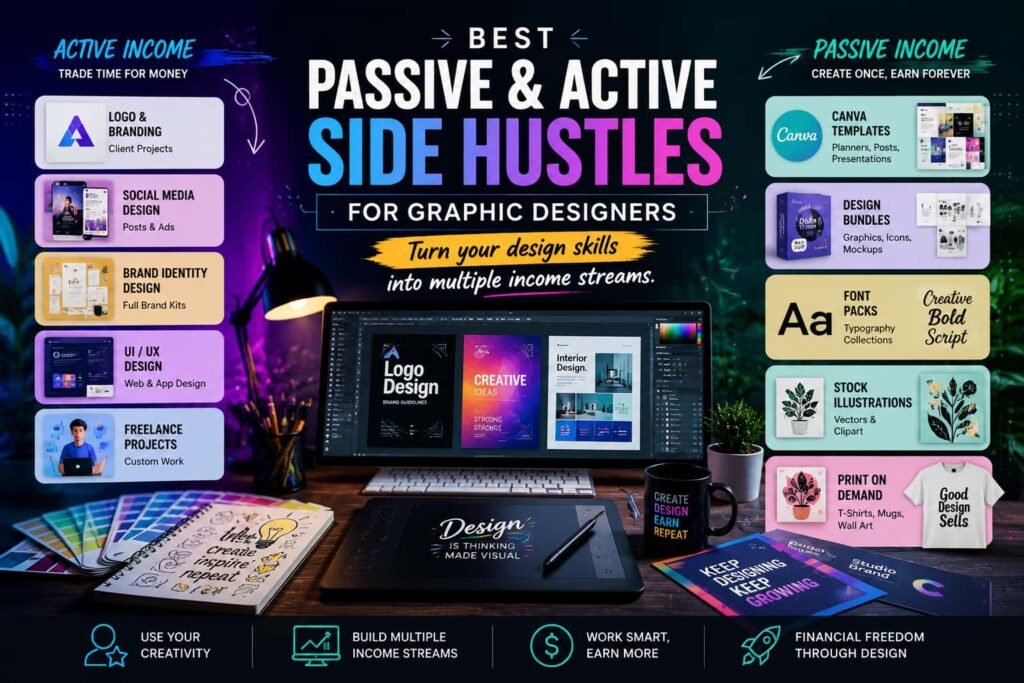

The obvious answer to side income as a graphic designer is more client work. Take on projects outside the day job, charge your own rate, keep the full fee. It pays well and the skills translate directly. However, the problem is that it replicates the exact dynamic that makes the day job feel limiting in the first place. Income is directly proportional to the hours you actively deliver. The moment you stop delivering, the income stops too.
A designer who wants supplementary income that compounds rather than simply scales is looking for something structurally different. Something that earns while the laptop is closed. Something where the creative work done on a Saturday morning continues generating income through the following months without requiring additional delivery.
This article covers both sides of graphic design side hustles. It covers the passive options that convert design skills into income assets that earn independently of active delivery, and the active options that leverage those same skills at significantly better rates than most employed design roles offer. Both have a place. The right combination depends on the individual designer’s available time, income goals and tolerance for the build phase that precedes passive earning.
The Graphic Designer’s Side Income Advantage
Before the specific options it helps to name what graphic designers bring to a side income context that most other professionals do not. The advantage is real, specific and worth understanding clearly before deciding where to direct creative energy.
A Universal Market and a Natural Fit for Products
Visual communication is commercially universal in a way that most professional skills are not. Every business, content creator, entrepreneur, non-profit and organisation needs compelling visual assets. Therefore, the market for design skills is not a niche with limited buyers. It is one of the broadest commercial skill markets in the professional services economy. For example, an accountant’s side income market is businesses needing financial expertise. By contrast, a designer’s side income market is essentially every organisation that communicates publicly, which is approximately all of them.
Digital product creation is structurally natural for designers in a way it is not for most other professions. A graphic designer creating a template pack, a brand identity kit, a social media asset library or a digital illustration set is doing work that is functionally identical to their primary professional output. The creative process is entirely familiar. What changes is the income model — from a one-time client delivery to a product that earns on every subsequent purchase without additional creative work.
Platforms Built Specifically for Design Output
Platform accessibility is higher for designers than for almost any other profession. Creative Market, Etsy, Design Bundles, Envato Elements, Adobe Stock and Redbubble all operate specifically to serve the designer side income market. As a result, each brings an established buyer base with purchase intent already attached. The designer does not need to build an audience from scratch. In other words, these are not general platforms adapted for designers. Instead, they are markets built specifically for design output.
The combination of universal market demand, natural fit with digital product creation and dedicated platform infrastructure makes graphic design one of the most accessible professional backgrounds for building genuine passive income. Furthermore, it is also one of the most underutilised, by employed designers who have not yet looked beyond the freelance client model.
Side Hustle Overview: Passive and Active at a Glance
The sections below cover each option in the detail needed to evaluate it honestly and start it practically.
| Side Hustle | Type | Est. Monthly Income | Build Phase |
| Design templates and assets | Passive | $500 – $2,500 | 3 – 6 months |
| Stock illustrations and vectors | Passive | $200 – $800 | 4 – 8 months |
| Print on demand design | Passive | $200 – $800 | 3 – 6 months |
| Design courses | Passive after launch | $300 – $2,000 | 4 – 8 weeks creation |
| Freelance brand identity | Active | $500 – $3,000/project | None — first client quickly |
| UI and UX consulting | Active | $75 – $150/hour | Minimal — portfolio required |
| Design workshops | Active + passive | $1,000 – $4,000/workshop | Minimal setup |
Passive Side Hustles for Graphic Designers
These options share the defining characteristic of passive income: the creative work is done once and the income continues on every subsequent sale without additional delivery involvement. The build phase is real — three to eight months of consistent work before reliable monthly income in most cases. But the passive phase that follows earns independently of creative hours thereafter.
Design Templates and Digital Assets
Design templates are the most direct translation of employed graphic design skills into passive income products. Canva templates, Adobe Illustrator files, InDesign layout packs, Photoshop mockups, brand identity kits, social media template sets, presentation decks and business card designs are among the consistently highest-selling product categories on Creative Market, Etsy and Design Bundles. A graphic designer creating these products works within an entirely familiar creative process. The difference is the output enters a product catalogue rather than a client folder.
What separates the template products that earn from the ones that sit undownloaded is specificity and professional completeness. For instance, a complete brand identity kit — primary logo, secondary marks, colour palette, typography pairing, icon set and usage guidelines formatted as an editable file package — consistently outsells five individual logo templates at the same combined price. That is because buyers are purchasing a system they can apply immediately, not an asset they need to finish. As a result, template products that deliver that complete, immediately usable experience generate positive reviews that compound discoverability over time.
Choosing a Platform and Pricing
Platform selection shapes the buyer and the price point. Creative Market attracts professional designers, marketing managers and brand-conscious small business owners with higher price tolerance and better quality expectations. Consequently, products priced at $25 to $75 convert well with the right audience. Etsy, by contrast, reaches a broader consumer market with lower price expectations but significantly higher buyer volume. Design Bundles focuses on bundle purchasing, which rewards having multiple complementary products rather than a single flagship item. For a complete guide to one of the most accessible categories within this space, the article on Canva templates as a side hustle covers selling them passively in full.
Realistic income from an established design template shop ranges from $500 to $2,500 per month with 30 to 50 well-positioned product listings across two or three focused niches. That income runs passively once the catalogue has accumulated reviews and search visibility, which typically takes three to six months of consistent listing activity.
The most efficient starting point for template passive income: identify one specific professional audience you understand well — real estate agents, fitness coaches, restaurant owners, podcast hosts — and build a complete visual brand kit specifically for that audience. Niche specificity generates more reviews, more repeat buyers and better word of mouth than generalist template packs that could apply to anyone.
Stock Illustrations and Vector Assets
Original illustrations, icon sets, pattern collections, vector character sets, decorative elements and infographic components have consistent commercial demand on Adobe Stock, Shutterstock, iStock and Freepik. A graphic designer’s existing illustration and vector skills produce exactly the type of content these platforms sell to buyers, without requiring new technical skills or unfamiliar workflows.
The passive mechanic is among the most durable available to a designer. For example, an illustration uploaded to Adobe Stock in January earns a royalty every time it is downloaded in February, June or three years later without modification or promotion. As a result, a portfolio of 500 to 1,000 targeted vector assets built over twelve to eighteen months of consistent uploading earns $200 to $800 per month from accumulated download volume. That income is entirely independent of the designer’s active creative schedule once the portfolio exists.
What Actually Sells on Stock Platforms
What sells on stock illustration platforms is worth understanding before investing significant upload effort. Generic decorative elements and abstract patterns compete against millions of existing uploads with minimal differentiation. By contrast, specific, authentic and commercially applicable illustrations generate downloads from buyers who cannot find these images elsewhere. Think professional scenario scenes with genuine diversity, niche industry iconography, culturally specific visual references, and technical diagrams for specific sectors. The same specificity principle that applies to template products also applies to stock illustration: the niche that feels too narrow to matter usually earns more than the broad category that feels safe. For a deeper look at how this model works across photography as well as illustration, the article on stock photos as passive income covers the full economics.
Adobe Stock deserves specific mention because of its integration with the Adobe Creative Cloud ecosystem. Designers already working in Illustrator and Photoshop can submit assets directly from Lightroom. In addition, the platform’s buyer base includes the professional creative community most likely to purchase high-quality vector work at rates that reflect its quality.
Print on Demand Design
Graphic designers are the natural candidates for print on demand income. This is because the professional quality floor they bring to product design creates a meaningful competitive advantage in a market where most sellers are working with consumer design tools rather than professional creative software. As a result, the difference in output quality is visible to buyers in ways that directly affect conversion rates and review quality. For a full breakdown of whether this model is worth your time, the article on print on demand side hustle covers the realistic numbers in detail.
Redbubble, Merch by Amazon and Printify integrated with an Etsy shop are the primary platforms. Each has different strengths. For instance, Redbubble has built-in buyer discovery and a creative community audience. Merch by Amazon, meanwhile, provides access to the largest retail buyer base available but has a selective approval process. Printify with Etsy combines Etsy’s buyer volume with Printify’s product range and fulfilment reliability.
The strategy that produces consistent print on demand income from a designer background is building cohesive collections for specific communities, rather than designing isolated products across unrelated categories. For example, a graphic designer who creates a cohesive set of 20 to 30 designs for a specific professional community builds a catalogue that generates repeat buyers and organic word of mouth within that community — with consistent visual language, shared references and a recognisable aesthetic. Individual unrelated designs compete on search alone. A coherent collection, however, builds a following.
Realistic monthly income from an established print on demand catalogue of 100 or more targeted designs ranges from $200 to $800 per month in the passive phase — meaningful supplementary income that earns alongside whatever active work the designer chooses to pursue.
Design Courses and Tutorial Content
Graphic designers who can explain their process clearly are creating genuinely scarce educational content when they build design courses. Most employed designers develop this ability through client presentations, internal reviews and stakeholder communication. Consequently, the gap between what is available in design education and what working designers actually need is visible in the review sections of every design course platform. Learners consistently cite a lack of real-world application, professional workflow context and explanation from someone currently working in a studio or agency environment.
Skillshare suits shorter technique-focused content — software tutorials, specific design techniques, workflow optimisations. It pays royalties based on watch time from premium members. For example, a class of 30 to 60 minutes covering a specific Illustrator technique or a brand identity workflow step can earn $200 to $600 per month passively once it has accumulated views and positive reviews. Udemy, by contrast, suits structured skill-building courses — a complete brand identity design course, a typography fundamentals programme, a social media design system course. It earns per enrolment rather than per minute watched.
Teachable and Gumroad suit designers who already have an audience — a blog readership, a social following, an email list — and want to sell directly at full margin without platform revenue sharing. For designers building from zero, however, Skillshare and Udemy provide the buyer discovery that makes passive enrolments possible without an existing audience.
Active Side Hustles for Graphic Designers
These options require active delivery per engagement — time in, income out. They do not compound passively. Instead, what they offer is access to income at rates that most employed design roles do not reach, from work that leverages existing skills directly without a build phase before the first payment.
What Brand Identity Work Pays
Brand identity work is the highest-value active design service available to most graphic designers. This is because it commands project fees that employed design salaries rarely approach on a per-project basis. For example, a complete brand identity project for a small business or growing startup — primary logo, secondary marks, colour system, typography pairing, brand guidelines document and basic asset delivery — earns $800 to $3,000 for work that a competent designer completes in ten to twenty hours of focused creative time. At the higher end of that range the effective hourly rate exceeds most senior employed design salaries.
The income premium over employed work exists because freelance billing captures the full project value directly. It does not route through an agency or studio that retains the majority before passing a salary fraction to the designer. The same skills, the same creative process, the same output — but the income structure is fundamentally different.
Finding Brand Identity Clients
Finding brand identity clients without a large existing network requires positioning rather than volume outreach. A portfolio that clearly signals specific brand identity expertise — not a general design portfolio but a focused collection of identity work — generates better conversion when combined with direct outreach to startups and small businesses in a specific sector. Likewise, LinkedIn, Behance and Dribbble all generate inbound inquiries from buyers actively looking for designers when the profile signals specialist expertise clearly.
Freelance brand identity work involves client communication, scope management and revision cycles that add time beyond the pure creative hours. For example, a project estimated at fifteen design hours often requires an additional five to eight hours of client management, feedback processing and file preparation. Therefore, build that overhead into the project fee rather than discovering it after the creative work is complete. Doing so protects both the income and the working relationship.
UI and UX Design Consulting
Digital product companies, SaaS startups, app developers and e-commerce businesses consistently need competent UI and UX design support on a project basis. The rate for this work — $75 to $150 per hour for experienced practitioners — sits significantly above most employed graphic design salaries. That is because the scope of the work includes both visual design and user experience thinking, which requires genuine professional competence to deliver well.
Toptal’s design network connects vetted designers with higher-rate clients than general freelance platforms. Therefore, it is worth applying to for designers with strong digital product portfolios. Upwork, by contrast, provides broader access at lower rates. Direct outreach via LinkedIn to product managers and founders at early-stage digital product companies generates the highest-rate engagements without platform fees. This is because the need for design support is most acute there, while the budget for a full-time hire is not yet justified.
This option suits graphic designers with digital product experience or a genuine willingness to develop it. A strong print and brand identity background does not automatically translate to UI and UX competence. The user experience thinking, the interaction design principles and the familiarity with design systems and component libraries that digital product work requires are learnable. However, they require investment before the consulting rate is justified.
Design Workshops and Training
Paid design workshops leverage the teaching and presentation skills that employed designers develop through years of client presentations and internal reviews. Marketing teams who need to produce better visual content, small business owners learning brand basics, non-profit communications staff developing visual communication skills, or aspiring designers building foundation knowledge are all viable audiences.
The format flexibility is significant. For instance, a live online workshop delivered through Zoom or a webinar platform reaches a geographically unlimited audience of 10 to 50 attendees at $50 to $200 per person. As a result, a single two to three hour session earns $500 to $10,000 depending on audience size and pricing. Similarly, an in-person workshop for a local business community or organisation earns similarly for a contained geographic audience. Both formats, moreover, can be recorded and sold as digital products after the live delivery, converting active income into a passive asset from work already completed.
The passive conversion opportunity is what makes workshop income particularly compelling for designers. A live workshop recorded and edited into a standalone digital product — sold through Gumroad, Teachable or a personal website — earns on every subsequent purchase without requiring the designer to deliver the session again. The live workshop is both immediate income and the production process for a passive product.
The Client Work Question
More freelance client work — taking on design projects outside the primary employer — is the option most designers default to when thinking about side income. It deserves an honest assessment rather than being dismissed or ignored.
Freelance client work is genuinely viable and often the fastest path to first side income for an employed designer. The rates are clear, the skills apply directly and the market is accessible without a build phase. For example, a graphic designer who takes on two brand identity projects per month at $1,000 each earns $2,000 of supplementary income from work that requires no new skill development and no platform learning.
The honest caveat is the one named in the opening: client work replicates the core dynamic of the day job. Income is proportional to active delivery and stops when delivery stops. Moreover, it does not compound, does not earn passively, and adds client management overhead on top of the creative work. As a result, a designer who spends every evening and weekend on client projects has more income but the same structural dependency. They also gain the creative fatigue that comes from design work consuming every available hour.
The most sustainable approach: use freelance client work as a cash flow foundation in the early stages while building one passive income stream alongside it. For instance, a template shop that takes six months to reach $500 per month in passive income is funded by the active client work running concurrently. Once the passive income is established, the designer can reduce client dependency rather than continuing to add more of it.
Choosing the Right Combination
The right starting point depends on what the designer wants most from their side income activity:
- Want passive income that builds over time — start with design templates on Creative Market or Etsy and stock illustrations on Adobe Stock. Both require a three to six month build phase before consistent passive income. The timeline for passive income article on this blog covers what to measure during that period to confirm progress is happening before income confirms it.
- Want maximum income per hour in the shortest time — freelance brand identity projects command the highest rates immediately available to a graphic designer with no build phase. A strong portfolio and one outreach conversation is the distance between today and first income.
- Want to teach and earn from the same creative knowledge — design courses on Skillshare or Udemy and paid workshops use the communication skills that employed design roles develop. Both convert existing professional knowledge into income without requiring new creative production.
- Want to start this weekend with zero setup cost — submit existing portfolio illustrations to Adobe Stock or Shutterstock. The submission process is free, the work already exists, and the passive royalties begin accumulating from the first download.
The combination that works best for most employed graphic designers: one passive income stream building in the background across evenings and weekends — a template shop or illustration portfolio — alongside selective freelance brand identity work when the rate and project type justify the client management overhead. The passive stream provides compounding long-term income. The freelance work, meanwhile, provides immediate premium income. Neither has to consume everything.
Design Skills Are More Scalable Than Most Designers Realise
Most graphic designers think of their skills as producing outputs sold once — to one client, for one project, at one price. However, the passive income options on this list reframe that relationship entirely. For example, a template pack is a design output sold to thousands of buyers over years. Similarly, a stock illustration is a creative asset that earns on every download indefinitely. And a design course is professional knowledge delivered to thousands of students without the designer being present for a single one of those deliveries.
The creative process that produces one deliverable for one client can produce an asset that earns from thousands of buyers over years. The skill is identical. The software is familiar. The creative thinking is the same. What changes, instead, is the income model — from one client paying once to many buyers paying repeatedly for the same creative work.
That shift, however, does not happen without a build phase. Templates need a catalogue. Illustrations need a portfolio. Courses need production time. None of the passive options earn immediately. But the designer who invests the evenings and weekends of the next six months in building one passive income asset will enter the following year with something earning independently of their active creative schedule. That something keeps working through client droughts, employment transitions and every other period when active design income is uncertain.
Pick one option from this article. Spend this weekend starting it. The creative skills that make someone a good designer are the same ones that make the passive options on this list genuinely achievable — not as a theory but as a practical first step taken this week. For a broader look at which digital products are worth building regardless of profession, the guide on best digital products to create once and sell forever covers the full range of options.