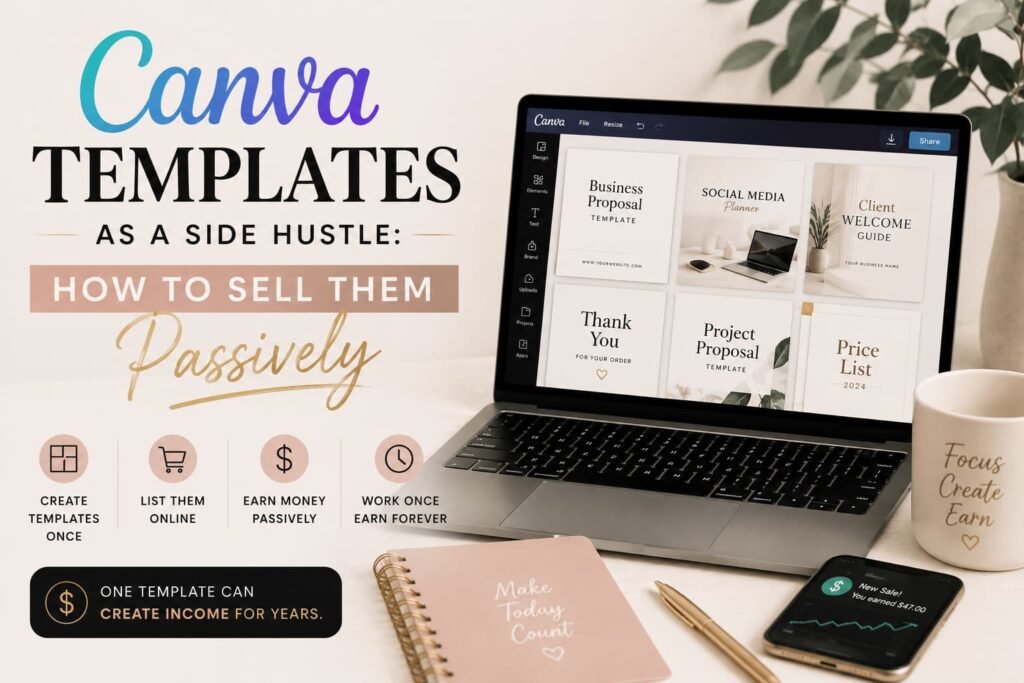

The appeal of a Canva templates side hustle is straightforward. You design something once using a tool most people already have free access to, list it on a marketplace, and earn a payment every time someone downloads it. No stock, no shipping, no client meetings, no ongoing fulfilment. The file does the work.
So if the model is that accessible, why does not everyone who tries it earn consistently from it?
The honest answer is that most people upload a handful of generic designs to overcrowded categories, see minimal sales in the first few weeks, and conclude the market is too saturated to enter. In most cases the problem is not saturation. It is positioning. The sellers earning consistently are not necessarily more talented designers. They have simply understood what buyers are actually searching for, where to find those buyers, and how to set up listings that make the selling genuinely passive.
This article covers all of that in practical terms — what to create, where to sell it, how to optimise for passive discovery, and what the income honestly looks like at different stages.
Why a Canva Templates Side Hustle Suits 9-5 Workers
Before the how, it helps to understand why this particular model suits a 9-5 worker’s constraints so well. There are four specific reasons it is worth considering seriously.
The financial barrier is zero. Canva’s free plan is sufficient to create professional-quality templates across every category that sells well. There is no software to purchase, no subscription required, and no inventory cost of any kind. The only input is time. That makes it one of the most genuinely accessible passive income models available.
The create-once-sell-forever mechanic is real and durable. A template pack designed during a Saturday morning session can generate income for years without modification. Unlike freelance work, a template earns every time it is downloaded. That happens regardless of what you are doing at that moment.
The demand is evergreen and growing. Businesses, content creators, students, coaches, consultants and professionals across every industry consistently need well-designed documents and graphics. Many of them would rather buy a polished template than build something from scratch. That demand does not diminish over time. If anything, the growth of content creation as a profession has expanded the market for quality templates significantly.
The income scales without proportional additional effort. The fifteenth listing in your shop earns alongside the first without the first needing to do anything differently. Adding more listings increases earning potential without increasing ongoing maintenance. A deeper catalogue in the same niche tends to earn more than a shallow one.
The passive phase of this model is genuine — but it follows an active build phase. Templates need to be designed, listed with strong keywords and professional imagery, and given time to accumulate reviews and search visibility before the truly hands-off earning begins. For most builders, that phase spans two to four months of consistent weekend effort. For a realistic picture of how this timeline compares to other streams, the guide on how long it takes to build passive income gives honest breakdowns for each option.
What Types of Canva Templates Actually Sell
This is the section that separates template sellers who earn consistently from those who do not. Most people who enter this market design what they think looks impressive rather than what buyers are actively searching for. Those are not always the same thing.
Categories With Consistent High Demand
Social media templates are the highest-volume category on Etsy for digital downloads by a significant margin. Instagram post packs, story templates, Pinterest pin collections, LinkedIn graphics and content calendar layouts sell consistently because the demand is structural. Content creators need new graphics every week. A well-designed template pack solves that problem repeatedly. A pack of ten to fifteen templates in a cohesive visual style sells far better than individual graphics because buyers want a visual system rather than a single asset.
Business templates carry higher price points and attract buyers with stronger purchase intent. Proposals, invoices, media kits, pitch decks, client welcome packets, pricing guides and project scope documents all perform well. The buyer perceives them as genuinely valuable professional tools rather than decorative assets. A consultant who needs a polished media kit will pay $25 to save three hours of design work without hesitation.
Resume and cover letter templates are perennially in demand regardless of economic conditions. Demand actually increases during periods of job market uncertainty — one of the more reliable passive income characteristics any template category can have. They are quick to create, search terms are well established, and buyers convert readily because the need is immediate and practical.
Planner and productivity templates — weekly planners, habit trackers, goal-setting worksheets, content calendars, budget trackers and project management layouts — have a broad and consistent buyer base. Seasonal versions, particularly around the new year and back-to-school periods, can generate significant short-term spikes on top of their year-round baseline.
Presentation and pitch deck templates command some of the highest price points in the market. Their perceived professional value is high. A well-designed 20-slide presentation template aimed at coaches or consultants can sell at $25 to $40 while requiring similar design time to a lower-priced social media pack. Volume is lower but income per sale is higher.
What Consistently Fails to Sell
Generic motivational quote graphics are the most reliably unprofitable category in the Canva templates side hustle market. The supply is overwhelming relative to demand. There is no differentiated buyer search intent that would lead someone to a new listing over an established one. Entering this category as a new seller is the fastest route to a shop that generates no sales.
Single-use templates without clear commercial application — decorative frames, abstract backgrounds, purely artistic layouts — suffer from unclear buyer intent. The buyer who needs a template is usually solving a specific, practical problem. A design that does not map to that problem does not convert regardless of visual quality.
Templates that require Canva Pro features without clearly stating this in the listing create one of the most damaging dynamics a new shop can experience. A buyer who discovers after purchase that they cannot access a font or element without a paid subscription will leave a negative review. Negative reviews in the early phase compound quickly and are extremely difficult to recover from. Design exclusively with free-plan accessible elements, unless the Pro requirement is stated prominently in the listing.
Before publishing any template listing, open it in a separate browser logged into a free Canva account and test every element. If anything is inaccessible without Pro, either replace the element or add a clear Pro requirement notice to the listing. This single check prevents the most common cause of early negative reviews for template sellers.
How to Create Canva Templates Worth Buying
Visual quality matters — but it is the second consideration, not the first. The primary quality standard for a sellable template is usability. The buyer should be able to open it, customise the text and colours for their brand, and have a finished, professional-looking result within ten minutes. No design skills or additional instructions needed.
Design for the buyer rather than for a portfolio review. Templates that look most impressive as static images are not always the ones that sell most consistently. Templates that are clean, structured, immediately editable and visually coherent across a full pack are the ones buyers return to and recommend.
Build in packs rather than singles. A pack of ten templates in a unified visual style is substantially more compelling than ten individual unrelated graphics at the same combined price. The pack communicates a visual system the buyer can build their content around. Individual templates communicate a one-off asset with limited utility.
Use only Canva-native fonts and free-tier elements unless you clearly state otherwise. A template with Pro-locked fonts that the buyer cannot access delivers a degraded experience from the first interaction. Canva’s free font library is extensive enough to produce professional results in every template category.
Label every editable element clearly within the template itself. Use text annotations to mark which sections the buyer should customise. Indicate which colours are tied to the brand palette and which elements are decorative. A buyer who immediately understands how to use the template leaves a positive review. One who feels confused does not.
The test for a completed template pack: hand it to someone unfamiliar with your design work and ask them to customise it for a fictional brand in ten minutes. If they struggle, the template needs clearer structure before listing. If they succeed, it is ready. This catches usability problems that are invisible to the designer but immediately apparent to the buyer.
Where to Sell Your Canva Templates
Platform choice directly affects how quickly templates gain visibility and how passively they sell once listed.
Etsy is the right starting point for most 9-5 workers building a Canva templates side hustle. It provides access to an enormous existing buyer base with purchase intent already established. Buyers searching Etsy for a resume template or social media pack are ready to buy. That purchase intent is what a new shop most needs. Etsy provides it without requiring any prior audience.
Etsy’s fees are modest but worth knowing precisely: a $0.20 listing fee per item, a 6.5% transaction fee on the total sale, and payment processing on top — together roughly 10 to 12% before any optional advertising. The more meaningful cost is the time invested in keyword optimisation. That determines whether listings surface in search or remain invisible. A template listed with generic keywords competes against thousands of established listings. The same template listed with researched, specific keywords competes against dozens. For a complete guide to the Etsy setup process and first-sale strategy, the article on the Etsy side hustle covers the cold-start problem in full.
Gumroad becomes a valuable secondary channel once a shop generates consistent Etsy sales and has an audience of any size — a blog readership, a social following, an email list — that can be directed to buy directly. Its flat fee of 10% plus $0.50 per sale makes it worth maintaining alongside Etsy as the shop matures. For the full trade-off comparison between marketplaces and your own storefront, the article on where to sell digital products online covers the key decisions in detail.
Creative Market is worth applying to once the shop has a catalogue of 15 or more polished listings and strong Etsy reviews. Its more selective buyer base is willing to pay higher prices. It is the natural expansion platform for a template seller who has established quality and demand on Etsy first.
Setting Up the Passive Selling System
The difference between a Canva templates side hustle that requires constant active attention and one that earns passively comes down to four infrastructure decisions made during setup. Getting these right at the start is significantly easier than retrofitting them to an established shop.
Keyword-Optimised Listing Titles and Tags
Search discoverability on Etsy is almost entirely determined by keyword coverage. The listing title, tags and description need to reflect the specific terms buyers actually use. The most reliable research method is typing the template category into Etsy’s own search bar and studying the autocomplete suggestions. These reflect real buyer searches ranked by volume. Study the titles and tags of the top five selling listings in the category. Then build a keyword strategy that covers the same ground with variations rather than duplicating identical phrases.
Every listing on Etsy allows 13 tags. Use all 13 with specific, varied keywords. Tags should cover the product type, the intended use, the target audience, and stylistic descriptors buyers might use to narrow their search. A resume template listing should include tags covering the product format, the industry or style, the career stage it suits, and the platform it is designed for.
Professional Mockup Images
Buyers do not see the template file before purchasing — they see the listing images. The quality and relevance of these images is the primary conversion factor. Every listing should have a minimum of three images. The first shows the full template or pack layout clearly. The second shows a close-up detail of the most compelling design element. The third shows the template in a realistic use context, such as on a device screen or in a lifestyle setting.
Canva itself can create professional mockup images. Device frame mockups, lifestyle scene generators and presentation-style layouts are all achievable within the free plan. The time invested in strong listing images directly determines conversion rate. A template with weak images will consistently underperform an equivalent template with strong ones regardless of design quality.
A Complete Shop Built Toward 20 Listings
Etsy’s algorithm favours established sellers over new ones. Buyers also make trust judgements based on how complete and active a shop appears. A shop with two listings signals a very new seller with unproven quality. A shop with twenty listings in a coherent niche signals an active, professional seller worth buying from. Building toward twenty listings before expecting consistent passive income is a realistic, evidence-based target.
The practical approach for a 9-5 worker is to batch design sessions on weekends. Dedicate two to three hours per session to creating and listing two or three templates. This is more sustainable than trying to create one listing per day across busy weekday evenings. Consistent weekend sessions produce a twenty-listing shop within two to three months without requiring significant weekday time.
An Early Review Strategy
Reviews are the most valuable asset a new Etsy shop can build and the most difficult to accumulate passively. Early buyers who have a positive experience often do not leave reviews without a prompt — not out of dissatisfaction but out of habit. Sending a brief, friendly follow-up message thanking them for their order and noting that reviews help a small shop grow is an entirely acceptable and widely practised approach. A shop with ten genuine five-star reviews converts at a significantly higher rate than an identical shop with zero.
Realistic Income: What a Canva Templates Side Hustle Actually Pays
The income from a Canva template shop is real, recurring and genuinely passive once the shop reaches critical mass — but it is modest rather than spectacular for most sellers. Being honest about that distinction matters before someone invests months of weekend effort building toward it.
A shop with 20 listings across two or three niches, each averaging ten sales per month at an average price of $10, earns roughly $2,000 per month. That is the upper end of what a focused, well-built shop achieves in its passive phase. Most sellers earn $300 to $800 per month from a shop with 20 to 30 listings — meaningful supplementary income rather than income replacement.
The timeline to first income is among the fastest of any passive income stream. Most new Etsy template shops generate their first sale within two to four weeks of opening. That is only possible if the listings are keyword-optimised and the mockup images are professional. Consistent monthly income that feels reliable arrives between months three and six as the shop accumulates reviews, gains algorithm favour, and builds listing depth.
Pricing too low is a more common mistake than pricing too high among new template sellers. A pack of ten Instagram templates priced at $2 signals low quality to buyers and earns too little per sale to compound meaningfully. Research the market price for each category and price at or near the midpoint of established sellers with similar quality. A fair market price converts buyers who are already searching for the product and builds the income foundation more reliably than discounting ever does.
Who This Canva Templates Side Hustle Actually Suits
This side hustle is worth pursuing seriously for a 9-5 worker who meets most of the following criteria honestly rather than aspirationally.
It suits someone who has a visual eye and finds design work engaging rather than tedious. The build phase requires two to four months of consistent weekend sessions — roughly two to three hours per weekend — to reach the listing depth and review count needed for passive income. That sustained effort is only sustainable if the design work itself is something the person genuinely enjoys.
It suits someone who can identify a specific audience and design for that audience’s practical needs rather than their own aesthetic preferences. The most successful template sellers belong to or deeply understand a specific professional or creative community. That insider knowledge produces templates that speak directly to what the buyer actually needs.
It suits someone patient enough to build toward 15 to 20 listings before expecting consistent monthly income. Someone who sees the shop as one income stream within a broader passive income strategy rather than a standalone solution. The income ceiling for most template sellers is real but modest — a reliable supplementary stream that compounds with catalogue depth.
It is less well suited to someone who finds design work draining, who needs income within the first 30 days, or who is approaching it without a clear niche in mind. In those cases, digital products built around written knowledge or affiliate content will likely produce better results per hour of effort. For a broader look at where this stream sits among all passive income options, the guide on passive income for 9-5 workers covers every option worth considering. For a look at other zero-cost digital product options, the article on passive income ideas that cost nothing to start covers the full range.
The Build Is a Weekend. The Earning Is Years.
A single Canva template pack designed on a Saturday morning, listed with researched keywords and professional mockup images, reviewed positively by its first buyers, and left alone to be discovered — that asset is still earning two or three years from now without being touched again. Not at life-changing scale from a single listing. But at a scale that compounds across a catalogue built over a few months of consistent effort.
The passive phase of a Canva templates side hustle is real and durable. The templates do not expire. The demand does not diminish. The listing does not require renewal or maintenance beyond occasional keyword refreshes. Every template added during the build phase adds to an earning asset that works independently of the time you subsequently invest elsewhere.
For a 9-5 worker with a visual eye and a specific audience in mind, the effort-to-earning ratio over a two to three year horizon is genuinely compelling. The build is concentrated in the evenings and weekends of a few months. The earning continues long after that concentrated effort ends. That asymmetry — front-loaded work, back-loaded reward — is the foundation of every passive income model worth building. The Canva templates side hustle delivers it at a lower barrier to entry than almost any other option. For a complete look at which digital products are worth building alongside or instead of templates, the guide on best digital products to create once and sell forever covers the full range of options.