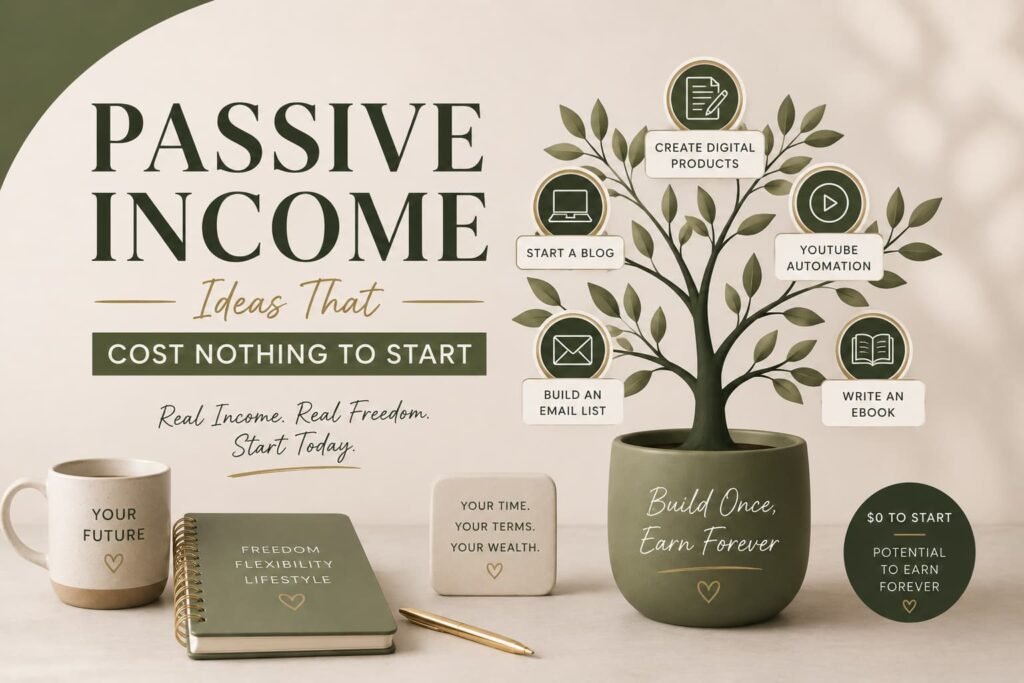

The most persistent myth about passive income is that you need money to build it. That you need to invest in stocks, fund a rental property, or buy into some programme before anything meaningful can happen. For someone working a 9-5 and living on a salary that leaves little room for financial risk, that belief alone is enough to make the whole idea feel inaccessible.
In reality, the ideas in this article do not require a single dollar to begin. No paid subscriptions, no inventory costs, no upfront fees of any kind. What they do require is something every employed person already has — time, knowledge accumulated through living and working, and the patience to build something before it pays.
That last part deserves saying clearly at the start: none of these ideas generate income overnight. What they generate instead is an asset — content, a product, a portfolio — that earns passively once it is built. The investment is your time and consistency, not your savings. For a 9-5 worker willing to spend evenings and weekends building something with a long runway, these are the most realistic passive income ideas that cost nothing available anywhere.
What ‘No Investment’ Actually Means Here
Before the list, it is worth being precise about what zero investment means in this context. Vague promises do more harm than good when someone is deciding where to spend their limited free time.
Zero investment means no money required to start earning. Every idea below can go from concept to first income without spending anything. The tools are free, the platforms are free, and the entry points are open to anyone with an internet connection and a device capable of running a browser.
However, zero investment does not mean zero effort. When you remove financial risk, the build phase relies entirely on your time and the quality of what you create. That is not a disadvantage. It means you can walk away at any point without having lost anything except time. Moreover, you keep 100 percent of the equity in whatever you build.
The Mindset Shift That Changes Everything
The most important mindset shift: you are not spending time on these ideas. You are investing time to build an asset that will work independently once it exists. That reframe changes how the slow early phase feels. It is also the reframe that separates people who follow through from people who quit.
Some of the options below have optional paid upgrades — better hosting, premium design tools, advanced platform features. None are required to start earning. They become worth considering once the free version generates consistent income and the upgrade would meaningfully increase it.
Affiliate Marketing Through a Free Blog or Content Platform
Affiliate marketing is the most accessible zero-investment passive income stream on this list. For most 9-5 workers it is also the most scalable. The mechanics are straightforward: you create content that recommends a product or service, include a tracking link, and earn a commission when a reader purchases through it. The content keeps earning long after it was written — which is what makes it passive.
The zero-investment entry point is through free content platforms. Specifically, Medium allows anyone to publish articles immediately with no setup cost. Pinterest lets you create pins that link to affiliate products. A free WordPress.com blog gives you a basic web presence without paying for hosting. All three can host affiliate content and generate commissions. For a direct comparison of how blogging and affiliate marketing actually work together, the guide on blogging vs affiliate marketing explains the relationship clearly.
Medium deserves particular attention for writers. Its Partner Programme pays writers based on reading time from paying members. As a result, an article can earn both affiliate commissions and direct platform income simultaneously. An article published today can still be earning two years from now if it continues attracting readers. That is the definition of passive income done right.
Platform Limitations and Content Strategy
Free platforms do come with limitations. A WordPress.com free plan restricts which affiliate programmes you can use and limits customisation. A self-hosted blog on a paid hosting plan removes those restrictions and opens significantly more earning potential — but it costs money. For a genuine zero-investment start, therefore, Medium and Pinterest are the cleaner options.
The content strategy is the same regardless of platform: write or create content that answers specific questions your target reader is already searching for, and place affiliate recommendations naturally within that content. A useful article about a tool, a platform comparison, or a genuine product review will outperform a thinly disguised promotional piece every single time. For a practical guide to how affiliate marketing works specifically for employed people, the article on affiliate marketing for 9-5 workers covers what actually works and what does not.
First affiliate commissions typically appear between one and three months of consistent publishing. Income compounds as the content library grows — each new piece adds another earning asset to the collection, and the older pieces continue working in the background.
Selling Digital Products Using Free Tools
Digital products are the passive income model with the best ratio of upfront effort to long-term return for most 9-5 workers. Furthermore, the tools needed to create basic versions of them cost nothing at all.
What you can build for free is more substantial than most people assume. For example, Google Docs produces professional written guides and ebooks that export as PDFs and sell directly. Canva’s free plan handles everything from social media template packs to printable planners, resume templates and workbooks. In addition, Notion’s free tier allows you to build and sell Notion templates — a growing category with consistent demand from productivity-minded buyers.
Where you sell matters as much as what you create. The best platforms for beginners cost nothing to join. Gumroad charges no monthly fee and takes a small percentage only when a sale is made — meaning you pay nothing until you earn something. Payhip operates on the same model. Similarly, Ko-fi allows digital product listings on its free plan and has a built-in audience of buyers already accustomed to supporting independent creators. For a full breakdown of where to list digital products and how each platform compares, the guide on where to sell digital products online covers the key decisions in detail.
Where Your Best Product Ideas Already Exist
The income potential here is genuinely significant over time. A digital product priced at $9 sold 50 times per month earns $450 passively. A $27 product sold 30 times earns $810. Those are not overnight numbers. They require a catalogue of products, some promotion, and time for listings to gain visibility. However, they are absolutely achievable for someone building consistently over six to twelve months without spending a cent on tools or platforms.
The most overlooked source of digital product ideas: your own 9-5 job. The knowledge you use daily — how to navigate a particular industry, how to structure a specific type of document, how to approach a professional situation — is genuinely valuable to someone earlier in the same career path. What feels routine to you feels like expertise to them. For a list of specific digital product formats worth building, the article on low-effort digital product ideas for 9-5 workers covers the options most suited to an employed schedule. For a longer-term view of which products earn repeatedly, the guide on best digital products to create once and sell forever is the most practical companion.
Who this suits best: anyone with knowledge worth packaging, even if that knowledge feels ordinary from the inside. Ordinary knowledge packaged specifically and sold to the right audience is one of the most reliable passive income foundations available.
Building a YouTube Channel
YouTube is free to join, free to publish on, and one of the very few platforms where content meaningfully compounds over years rather than days. A video published today can earn consistently three years from now if it targets the right search terms and serves its audience well. That long earning tail is what makes YouTube genuinely passive rather than just deferred active work.
The income mechanics work in layers. The YouTube Partner Programme pays ad revenue once a channel reaches 1,000 subscribers and 4,000 watch hours — passive income that accumulates as long as videos keep being watched. In addition, affiliate links in video descriptions earn commissions independently of ad revenue. Digital products promoted within videos add a third income layer for creators who have them.
For 9-5 workers who are not comfortable on camera — or simply do not want their professional identity connected to a side channel — faceless YouTube is a well-established and growing format. Channels built around screen recordings with voiceover, slideshow-style presentations, animated explainers, or text-on-screen content perform consistently across dozens of niches. No camera required. No particular appearance required. For a direct comparison of the two approaches, the article on faceless or on-camera YouTube lays out the trade-offs clearly.
Free Tools and Realistic Timelines
The editing tools required cost nothing. DaVinci Resolve is a professional-grade video editor available entirely free. CapCut handles simpler edits quickly and without cost. Canva produces thumbnails for free. As a result, the entire production pipeline from script to published video runs without spending anything.
YouTube has the longest runway of any option on this list. Most channels reach the monetisation threshold between six and eighteen months of consistent publishing. The passive income phase is real and substantial once it arrives. However, the path there requires patience that many people underestimate before they start. For a direct comparison of YouTube against blogging as a route to passive income, the article on blogging or YouTube for 9-to-5 workers is worth reading before you choose.
What makes YouTube worth the long build for a 9-5 worker is the ceiling. A modestly successful channel in a focused niche can generate more passive income than most other options on this list combined. The time investment is significant, but the compounding is genuine and the platform has over two billion monthly users searching for content every single day.
Licensing Your Photos or Artwork
For readers who already produce visual content as part of their creative life — photography, digital illustration, graphic design, or traditional art that can be photographed cleanly — stock licensing is a zero-investment passive income stream that monetises work they would be creating anyway.
The model is simple. You upload images to stock platforms. When a buyer licenses or downloads your image, you earn a royalty. The image continues earning each time it is downloaded, indefinitely, without any further work on your part. Consequently, one image can earn dozens or hundreds of times over its lifetime on a well-trafficked platform.
The submission process on major platforms is entirely free. Shutterstock, Adobe Stock and Getty Images all accept applications from independent contributors at no cost. Redbubble lets artists and designers upload artwork and earn from product sales without any upfront fees. For photographers specifically, Alamy offers one of the higher royalty rates among major stock platforms and accepts a wide range of subject matter. For a realistic look at what stock photography actually earns month to month, the breakdown on stock photos as passive income covers the honest numbers.
What Actually Sells and How It Compounds
What sells consistently on stock platforms is not what most beginners assume. Generic landscape photography and obvious compositional choices are already represented by millions of uploads. In contrast, what buyers are actively searching for — and often struggling to find — is specific, authentic and diverse imagery. Genuine workplace scenarios, culturally specific situations, niche hobbies, underrepresented communities, and everyday moments that feel real rather than staged.
The compounding dynamic on stock platforms rewards patience in a very specific way. A portfolio of 50 images might earn $30 to $60 per month. A curated portfolio of 500 images positioned in underserved niches can earn $300 to $700 per month from the same passive mechanic — just at greater scale. The work is in building the portfolio. The earning happens afterward.
Who this suits: photographers, illustrators and visual artists who already produce image content regularly and want to earn from it without additional creative work. If creating images is already part of your life, this is the closest thing to genuinely effortless passive income on this list.
Writing on Medium Through the Partner Programme
Medium sits in an interesting position among passive income options for writers — simultaneously one of the most accessible and one of the most underestimated. The platform pays writers a share of subscription revenue based on reading time from paying members. Write an article that people genuinely engage with, and it earns as long as readers keep finding it.
The entry point is completely free. Creating a Medium account, joining the Partner Programme and publishing your first article costs nothing and takes less than an hour from start to finish. There is no hosting to configure, no design decisions to make, no technical setup of any kind. You write, you publish, and the platform handles everything else.
What earns well on Medium follows the same principle as every other content platform on this list: specificity and genuine usefulness outperform broad opinion pieces every time. Practical articles that walk readers through a real process, experience-based pieces that share honest lessons, and well-structured explainers that make a complex topic accessible — these are the formats that accumulate reading time and therefore income.
Honest Earnings and Platform Risk
The earning ceiling on Medium is worth being honest about. A single article that resonates widely can earn hundreds of dollars in a month. Most articles, however, earn between one and ten dollars per month once the initial readership settles. The passive income comes from building a library of articles — ten pieces each earning five dollars per month produces fifty dollars passively. Fifty pieces each earning five dollars produces two hundred and fifty. The mathematics of compounding content libraries applies here exactly as it does everywhere else.
Medium’s income is platform-dependent in a way that a self-hosted blog is not. If the platform changes its payment structure or your account is restricted for any reason, that income can be disrupted. Therefore, treat Medium as a strong starting point and a supplementary income stream rather than a permanent primary one. Building toward your own platform alongside it is a sensible long-term strategy. For a practical guide to earning from a blog without daily posting requirements, the article on how to earn from a blog without posting every day is a useful companion.
The secondary benefit of writing on Medium deserves mention: it builds writing discipline, creates a public portfolio of work, and develops the content creation habit that transfers directly to every other passive income option on this list. For a complete beginner who wants to start earning while building skills simultaneously, Medium is the most efficient single starting point available.
How to Choose Which One to Start With
Five options is enough to create paralysis if there is no framework for choosing. Here is a direct decision guide based on where you are right now:
| Your Situation | Best Starting Option | Why |
| You enjoy writing and have a subject area | Medium or affiliate blog | Lowest setup friction, starts earning fastest |
| You have professional knowledge to package | Digital products | High margin, one product can sell indefinitely |
| You are comfortable explaining things on video | YouTube channel | Highest long-term ceiling of any option here |
| You already create photos or artwork regularly | Stock licensing | Monetises existing creative output with no extra work |
| You want the fastest possible start with no decisions | Medium Partner Programme | Account to first article in under an hour, zero setup |
The deciding factor beneath all of it is which option you will actually sustain for three to six months without immediate financial feedback. Motivation matters more than strategy at the beginning. In other words, the best passive income idea is the one you follow through on, not the one that looks best on paper. If you are still stuck between two options that both seem viable, the guide on how to choose between two side hustles walks through the decision clearly.
One firm piece of advice regardless of which option you choose: start with one and only one. The instinct to hedge by pursuing multiple streams simultaneously feels prudent but produces the opposite result in practice. Divided attention means none of the streams gets enough consistent effort to gain traction. Consequently, full attention on a single option for three focused months will move you further than fragmented effort across five options for a year.
Pick the option that matches your existing skills most closely. The learning curve on a familiar format is shorter, the quality of your early output is higher, and the sustainability of the effort is significantly better. Competence builds momentum. Struggling with an unfamiliar format from the start builds frustration instead.
The Real Investment
The barrier to passive income ideas that cost nothing has never really been money. The tools are free. The platforms are free. The entry points are open. What has always been the actual barrier is the willingness to invest time and consistency over months without seeing immediate returns — and to keep going through the slow early phase when it would be easier to conclude that it is not working.
That particular kind of patience is something a 9-5 worker building a side income stream already understands. You show up to your job every day for a salary that arrives at the end of the month. You are already practising the discipline of deferred reward. Passive income simply extends that timeline and replaces the guaranteed salary with an income that eventually runs without requiring your presence at all.
The ideas on this list are free to start. The path is clear. The remaining question is not whether you can afford to begin — it is which one you start this week. For a realistic picture of how long each of these income streams takes to reach the passive phase, the guide on how long it takes to build passive income gives honest timelines for each stream covered here.