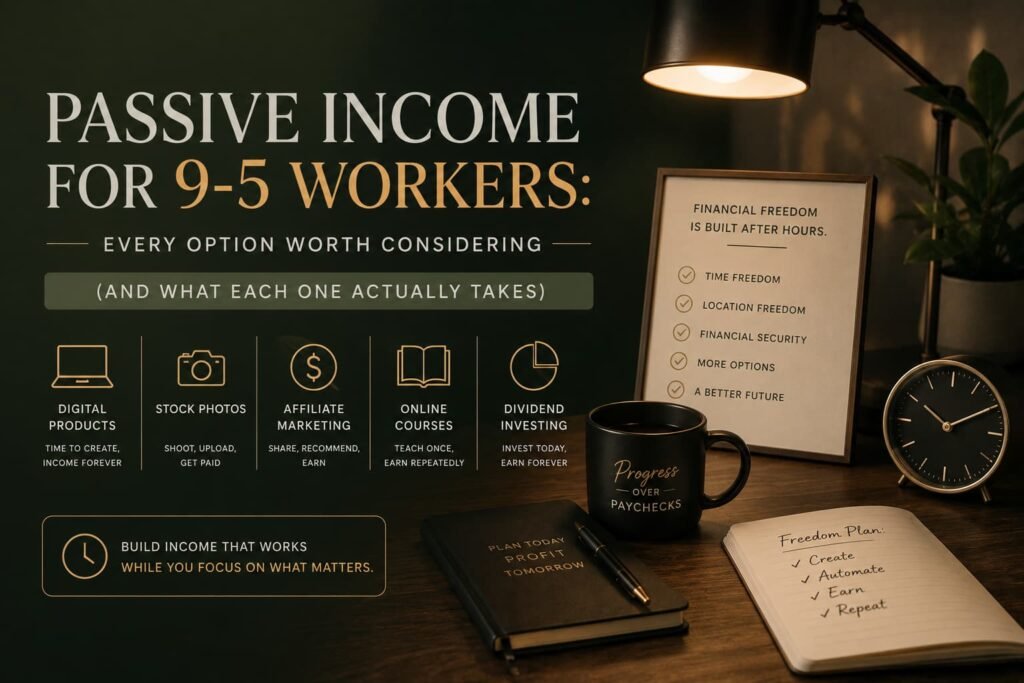

The concept of passive income is everywhere. Type the phrase into any search engine and you will find thousands of articles, videos and social media posts all selling variations of the same dream — build something once, earn from it forever, escape the trading of time for money that a 9-5 job demands. The idea is compelling. The problem is the information.
Most passive income content does one of two things. It either picks a single stream and oversells it without honest context, or it lists thirty options with so little depth that you finish reading with more confusion than you started with. Neither approach helps a person with a full time job, a finite number of free hours, and a genuine need to make a good decision about where to invest their limited time.
This article takes a different approach. It covers every passive income for 9-5 workers stream worth considering — not to excite, but to inform. Each option is assessed on the same honest terms: what it involves, what it actually requires before it pays, how long it realistically takes, and who it suits most given the constraints of someone already employed full time.
By the end, you will have a complete and honest map of the landscape. More importantly, you will have a clear framework for choosing your starting point. The goal is not more research — it is a well-informed decision, made today, that you can actually follow through on.
What Passive Income for 9-5 Workers Actually Means
The textbook definition of passive income is income earned with minimal ongoing active effort after an initial period of work or investment. That phrase — after an initial period — is the part most popular treatments quietly omit. It is also the part that makes the concept less immediately appealing and more honestly achievable.
Every passive income stream has a build phase. This is the period of active, often unrewarded work during which the asset is being constructed — whether that is a blog, a product, a portfolio of photographs, or an investment account. During this phase, the income may be negligible or entirely absent. The passive earning comes after the asset exists and has reached the threshold where it generates returns without requiring your continued presence.
For a 9-5 worker, the build phase happens in the margins of a schedule that already contains a full time job. Evenings after work, weekend mornings, lunch breaks and annual leave are the raw material. The question is not whether passive income for 9-5 schedules is achievable — it clearly is. The question is which stream matches your specific margins, the skills you bring to the build phase, and the timeline you can realistically sustain.
The Capital vs Time Trade-Off
The right passive income stream is not the one with the highest ceiling or the most appealing concept. It is the one that fits your actual available time, your existing skills, and your tolerance for building something before it earns. Everything that follows is a tool for making that match accurately.
One more framing point worth establishing at the start: the less money you invest upfront, the more time the build phase demands. Conversely, the more capital you can deploy, the less active work is required to reach a passive earning position. Every option on this list lives somewhere on that spectrum. Understanding where each one sits is the foundation for making a good choice. For the honest story of how long each stream actually takes, the guide on how long it takes to build passive income gives stream-by-stream timelines.
The Passive Income Spectrum
Rather than treating passive income as a simple category, it helps to think of it as a spectrum with two dimensions — how intensely the build phase demands your active effort, and how genuinely passive the earning becomes once the asset is established. The table below maps the major options against both dimensions to give you an immediate reference point before the detailed sections that follow.
| Stream | Build Intensity | Passive Phase Quality | Min. Timeline to First Income | Capital Required |
| Digital Products | Medium | High | 1–3 months | None |
| Affiliate Content | Medium–High | Very High | 2–4 months | None |
| Stock Photography | Medium | High | 3–5 months | None |
| Print on Demand | Medium | High | 1–3 months | None |
| YouTube | Very High | Very High | 12–18 months | None |
| Online Courses | High | Very High | 1–4 months | None |
| Dividend Investing | Low | Very High | Immediate | Significant |
Use this table as a navigation tool rather than a fixed ranking. The streams with the highest build intensity are not worse options — they simply require more front-loaded commitment before the passive earning begins. For someone with a clear skill and genuine patience, a high-intensity build stream may produce far more income over three years than a low-intensity one started in the same week.
Digital Products

Digital products are consistently the passive income for 9-5 workers stream with the best ratio of upfront effort to long-term return. The core mechanic is straightforward: you create a sellable asset once and distribute it an unlimited number of times without any additional production cost. Every sale after the first is pure margin.
The range of what qualifies as a digital product is broader than most people initially assume. Written guides and ebooks, design templates, printable planners and worksheets, Notion and Canva template packs, preset collections for photographers, swipe files, resource libraries, and mini courses all fall within this category. The common thread is that each exists as a file that can be purchased, downloaded and used without any physical fulfilment.
Why It Suits a 9-5 Schedule
The creation phase fits naturally into evenings and weekends. An ebook can be drafted across a series of late evenings using nothing more than a Google Doc. A template pack can be assembled over a weekend on Canva’s free plan. Once the product is listed on a platform like Gumroad, Payhip or Etsy, it earns whenever someone finds and purchases it — whether you are in a meeting, asleep, or on holiday.
What It Honestly Requires
A clearly defined audience with a specific, recurring problem. A product that solves that problem more accessibly than free alternatives. And a platform to sell from that gets the product in front of buyers rather than waiting for them to find it through chance. The product idea is almost always hiding in plain sight — the knowledge you apply daily in your 9-5 is often exactly what someone earlier in the same career path would pay to access.
Realistic Timeline and Income
First sales typically appear within one to three months for a well-positioned product with some basic promotion. Meaningful recurring income — the kind that feels genuinely passive — takes three to six months of iteration and audience building. The ceiling is high. A single well-targeted digital product can earn for years. A catalogue of complementary products compounds that earning significantly over time.
For the full breakdown of which digital products work best, which tools are free to use, and how to choose the right product for your skill set, read: Best Digital Products to Create Once and Sell Forever and Low-Effort Digital Product Ideas for 9-5 Workers.
Affiliate Marketing Through Content

Affiliate marketing is the most scalable zero-investment passive income for 9-5 option on this list — and the one with perhaps the widest gap between how beginners understand it and how it actually works for people earning from it consistently.
The mechanics are simple. You create content — articles, videos, newsletters, social posts — that recommends products or services genuinely useful to your audience. Each recommendation contains a tracking link. When a reader clicks that link and makes a purchase, you earn a commission. The content continues earning as long as readers keep finding it. A single article written on a Sunday afternoon can therefore generate commissions every month for three years without being touched again.
Why It Suits a 9-5 Schedule
The content creation phase fits into small time windows. A blog article takes two to three hours to research and write. A short video takes a similar investment. Once published and optimised for search, that content works independently of your time. The earning is proportional not to how many hours you put in today but to how much content you have accumulated over the past months — a compounding dynamic that rewards consistency over intensity.
What It Honestly Requires
A content platform — a self-hosted blog for maximum flexibility, Medium for a zero-cost start, Pinterest for visual niches, or YouTube for video-based affiliate content. A consistent publishing rhythm that prioritises quality over frequency. And the discipline to create content that genuinely serves the reader first. Readers and search engines both penalise content that reverses that priority.
Realistic Timeline and Income
First affiliate commissions typically appear between one and three months of consistent publishing. Meaningful recurring monthly income usually takes six to twelve months of sustained effort to establish. The ceiling is very high. Well-positioned affiliate content in focused niches can generate more from a single highly-ranked article than most people earn from weeks of active work. Moreover, the compounding nature of the model means each piece of content added to the library increases the earning capacity of everything already there.
For the detailed breakdown of how affiliate marketing compares to blogging, which platforms are worth starting with, and how to build affiliate income around a 9-5 schedule, read: Blogging vs Affiliate Marketing: The Real Difference Isn’t What You Think and How to Earn From a Blog Without Posting Every Day.
Stock Photography and Visual Assets

For anyone who already creates visual content — whether as a deliberate practice or as a byproduct of a creative lifestyle — stock photography and digital asset licensing offer a genuinely low-friction entry into passive income for 9-5 earners. The core appeal is that you are monetising work you would be producing regardless of the income opportunity.
The licensing model works as follows: you upload images, illustrations or digital artwork to platforms that serve commercial buyers — designers, marketers, publishers, businesses building websites and content. Each time a buyer downloads or licences your work, you earn a royalty. The asset keeps earning every time it is used, indefinitely, without any further effort from you.
Why It Suits a 9-5 Schedule
A single dedicated shooting or creation session over a weekend morning can produce assets that generate income for years. The ongoing maintenance — reviewing analytics, updating keywords, submitting new work periodically — requires one to two hours per month once the portfolio is established. The passive phase is genuine and the compounding effect of an expanding portfolio is one of the most reliable in any passive income model.
What It Honestly Requires
A portfolio positioned in commercially relevant niches with strong, specific keywording. Generic landscape photography and obvious lifestyle imagery are already oversupplied on every major platform. In contrast, authentic, specific, and underrepresented imagery — real workplace scenarios, diverse subjects, niche communities and cultural contexts — earns consistently because it fills gaps buyers are actively searching to fill.
Realistic Timeline and Income
A portfolio of 100 images earns approximately $10 to $30 per month. A curated portfolio of 500 images in focused niches earns $80 to $200 per month. At 1,000 or more targeted images, monthly income reaches $200 to $600 — and sometimes significantly beyond that in high-demand niches. The build phase takes patience. Most contributors need 200 to 300 submitted images before consistent monthly downloads begin. However, the earning thereafter requires almost no active effort.
For the complete breakdown of which platforms pay the most and how to build a stock portfolio around a full time job, read: Stock Photos as Passive Income: Can You Actually Make Money?
Print on Demand

Print on demand sits at an interesting intersection between passive income and creative expression. The model allows you to design products — t-shirts, mugs, tote bags, phone cases, wall prints and more — upload those designs to a platform, and earn a margin every time a customer orders. The platform handles production, payment processing and shipping entirely. You are never involved in the fulfilment process.
The appeal for a 9-5 worker is clear: no inventory, no upfront cost, no physical handling of products. The design work is the entire contribution, and once a design is live it earns passively for as long as buyers continue finding and purchasing it.
Why It Suits a 9-5 Schedule
Design sessions fit naturally into evenings and weekends. Canva’s free plan handles basic design work effectively for contributors in many niches. Once designs are listed, they require no ongoing attention unless you choose to run promotions or optimise keywords periodically.
What It Honestly Requires
A catalogue of niche-specific designs rather than generic ones — this distinction determines almost everything about whether print on demand earns meaningfully. The platforms are saturated with generic motivational quotes and basic graphic designs. Designs that speak directly to a specific community, profession, hobby or identity consistently outsell generic equivalents. Building a catalogue of 100 or more targeted designs is the realistic threshold for generating consistent monthly income.
Realistic Timeline and Income
Most contributors see their first sales within one to three months. However, consistent monthly income typically requires three to six months of steady catalogue building. Income per sale ranges from $2 to $15 depending on the product type and your pricing. Volume is the income driver — which is why catalogue depth matters more than individual design quality in most niches.
YouTube

YouTube is the longest build but potentially the highest ceiling of any passive income for 9-5 stream on this list. It is also the one most often underestimated by people who have not looked carefully at how it compounds over time.
A video published today earns in year one, year two and year three if it continues attracting viewers. Unlike social media content with a lifespan measured in hours or days, YouTube videos indexed by Google can surface in search results for years after publication. That long earning tail — combined with multiple simultaneous income layers — is what makes the model genuinely compelling despite the demanding build phase.
Why It Suits a 9-5 Schedule
The faceless YouTube format has matured significantly and now represents a substantial portion of successful channels across dozens of niches. Screen recordings with voiceover, slideshow-style presentations, animated explainers and text-on-screen content all perform consistently without requiring the creator to appear on camera. This removes both the discomfort many professionals feel about public visibility and the equipment cost associated with high-quality on-camera production.
What It Honestly Requires
Consistent publishing over a sustained period — typically six to eighteen months — before reaching the YouTube Partner Programme’s monetisation threshold of 1,000 subscribers and 4,000 watch hours. Niche focus matters enormously. A channel covering one clearly defined topic for a specific audience grows faster and monetises more effectively than a broad channel covering multiple unrelated subjects. Quality of content matters more than production value, particularly in the early phase.
Realistic Timeline and Income
YouTube has the longest runway of any option in this guide. Most channels reach meaningful passive income between twelve and twenty-four months of consistent effort. The income streams compound once established — ad revenue, affiliate commissions and digital product promotion can all operate simultaneously from the same channel. For a 9-5 worker willing to commit to this timeline, YouTube represents one of the most substantial opportunities available without financial capital.
YouTube demands the most sustained commitment before the passive phase begins. Therefore, if that timeline feels unrealistic given your current circumstances, start with a faster-return stream first. Return to YouTube once you have supplementary income providing some financial breathing room. For the comparison of YouTube against blogging, read: Blogging or YouTube for 9-to-5 Workers: What Pays Sooner and Lasts Longer and Faceless or On-Camera YouTube: Which Is Better for a Side Hustle?
Online Courses and Digital Workshops

Online courses occupy a distinctive position in the passive income landscape because they convert professional expertise into a scalable income asset. Every time a new student enrols in a course you have already built and recorded, you earn without doing any additional teaching work. The course content exists independently of your time. This is the purest expression of passive income for 9-5 knowledge workers: the expertise earns on its own schedule, at scale, without you being available.
The Mini Workshop Entry Point
A full multi-module online course is an intimidating starting point for most 9-5 workers, and rightly so — the production time is significant and the scope can become overwhelming quickly. A mini workshop is a more practical entry. A focused 45 to 90 minute video training that walks a specific audience through one specific process — priced between $27 and $97 — can be created in a dedicated weekend and listed for sale immediately.
The mini workshop teaches you the course creation workflow, gives you your first paying students, generates early reviews, and validates the audience’s willingness to pay before you invest weeks in a larger course. It is the right starting point for most 9-5 workers exploring this stream.
What It Honestly Requires
A clearly defined transformation for the student — what they will be able to do after completing the course that they could not before. A curriculum that delivers on that transformation without padding. And a promotion strategy that gets the course in front of the people who need it. The last requirement is what most course creators underestimate — a brilliant course with no promotion strategy earns nothing.
Realistic Timeline and Income
First enrolments can appear within weeks for creators with an existing audience. Building that audience from scratch adds three to six months to the timeline. Income per enrolment ranges from $27 for an entry-level mini workshop to several hundred dollars for a comprehensive course. A course that enrols 20 students per month at $47 generates $940 passively. One that enrols 50 students at $97 generates nearly $5,000. The ceiling is among the highest of any digital income stream.
The 9-5 job is often the richest source of course ideas available. The knowledge you apply daily is exactly what someone earlier in the same career path would pay to learn. The course already exists in your experience. The work is packaging it.
Dividend Investing and Interest Income
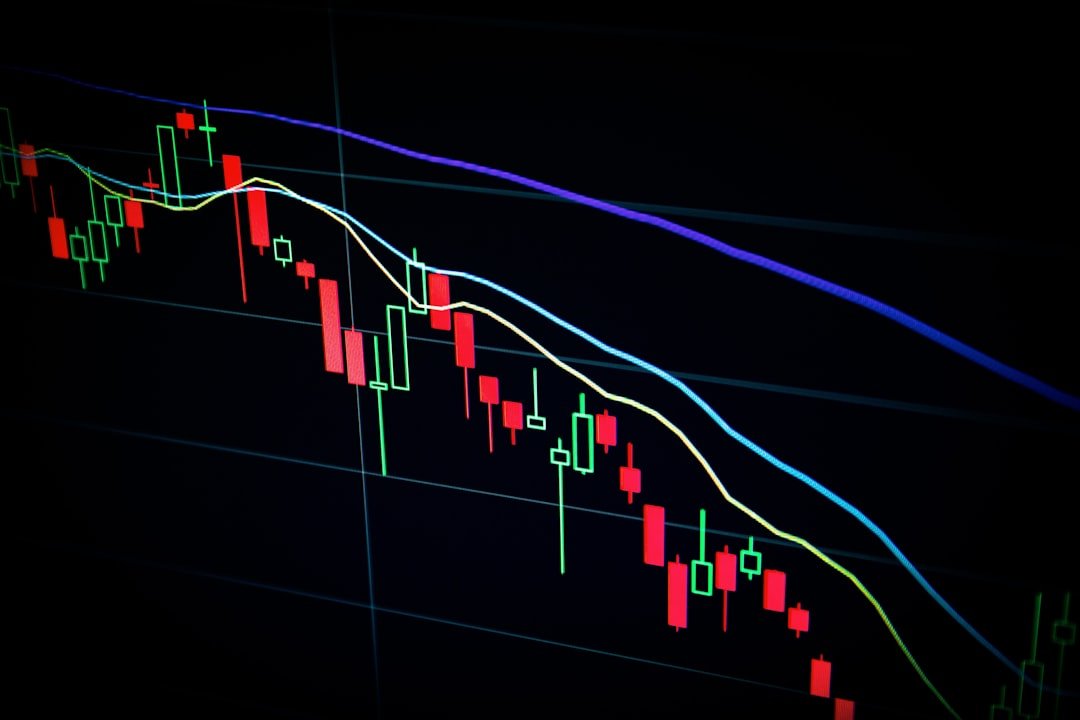
Dividend investing deserves a place in any complete passive income overview because it is the model that most closely matches the textbook definition — income generated by capital rather than by effort. Once the investment is made, no further active work is required. Dividends arrive on a schedule, interest compounds in the background, and the income is entirely independent of your time.
Dividend-paying stocks, index funds with distribution reinvestment options, and high-yield savings accounts or bonds all fall within this category. The mechanics vary but the principle is consistent: money working on your behalf rather than hours working on your behalf.
The honest barrier is capital. Meaningful passive income from dividends requires a substantial portfolio. The income scales directly with the amount invested. As a result, the accessibility of this stream depends entirely on disposable income available for investment — a constraint that varies enormously between individuals. For 9-5 workers with limited disposable income, dividend investing is a long-term destination rather than a starting point.
Note: This section covers dividend investing as part of a comprehensive passive income overview only. For specific investment decisions, tax implications, and financial planning, consult a qualified financial adviser. The right investment strategy depends on individual circumstances that a general blog article cannot account for.
How to Choose Your Passive Income for 9-5 Starting Point
Having a complete map of passive income options is only useful if it ends in a decision rather than continued research. The table below translates your current situation directly into a recommended starting stream and a concrete first step:
| Your Situation | Best Starting Stream | First Step This Week |
| Have professional knowledge worth packaging | Digital product or mini workshop | Write down the one problem your knowledge solves for someone earlier in your career path |
| Enjoy writing and have a subject area | Affiliate content blog | Choose a niche, register a domain, publish your first article |
| Already create photos or visual content | Stock photography | Create a Shutterstock or Adobe Stock contributor account and submit 10 images |
| Creative, enjoy design | Print on demand | Create a Redbubble or Merch by Amazon account and upload 5 niche-specific designs |
| Comfortable on video or willing to try faceless | YouTube | Define your channel niche and script your first video |
| Have disposable income to invest | Dividend investing | Consult a financial adviser and review index fund options |
| Want to start earning immediately with minimal setup | Digital product | Create one focused product this weekend and list it on Gumroad |
The Sustainability Test
The table above is a starting framework, not a fixed prescription. The deciding factor beneath all of it is sustainability — which option will you actually maintain for three to six months without immediate financial feedback? Motivation, interest and genuine fit with your existing skills matter more than the income ceiling on paper. The highest-ceiling stream pursued inconsistently will always underperform a lower-ceiling stream pursued with focus and patience.
Three questions are worth sitting with before making the choice. First, what do you already have — time, a specific skill, a creative practice, or capital? The answer points directly toward two or three options that suit you. Second, what is your honest tolerance for a slow build? If twelve to eighteen months without meaningful income feels genuinely unsustainable, eliminate the longer-runway streams. Third, what type of work feels sustainable on a consistent basis — writing, designing, photographing, teaching or investing all require different things from you.
Start With One Stream Only
One firm rule regardless of which stream you choose: start with one and only one. The instinct to pursue multiple streams simultaneously feels prudent but produces the opposite result in practice. Divided attention means none of the streams receives enough consistent effort to compound. In contrast, full attention on a single stream for three to six focused months will move you further than fragmented effort across five streams for a year. If you are still deciding between two options that seem equally viable, the guide on how to choose between two side hustles walks through the decision clearly.
The Map Is Not the Journey
A comprehensive map of passive income for 9-5 options is a useful thing. What it is not is a substitute for the decision that follows reading it. The trap most people fall into is treating the research itself as productive — gathering information, comparing options, bookmarking articles — while the actual starting point remains perpetually deferred to next week, next month, or when circumstances feel more ready.
Circumstances rarely become more ready. The 9-5 schedule does not free up time spontaneously. The bank account does not grow a buffer on its own. The right moment to begin is not a moment that arrives — it is a decision that is made, with imperfect information and imperfect conditions, and followed through with consistency over the months that come after.
The Only Step That Remains
Every stream covered in this article has been researched honestly. The timelines are real. The income ranges are real. The requirements are real. You now have enough information to make a genuinely well-informed choice. The only remaining step is making it — and committing to the stream you choose for long enough that the compounding has a chance to work.
Pick the option from this guide that fits your situation most closely. Follow the link to the dedicated article for that stream. Then spend this weekend taking the first concrete step — creating the account, outlining the product, or submitting the first image. The passive income starts the moment the asset does.
Go Deeper on Each Stream
Every section in this guide links to a dedicated article with the full breakdown for that stream. Here they all are in one place:
Best Digital Products to Create Once and Sell Forever · Low-Effort Digital Product Ideas for 9-5 Workers · Passive Income Ideas That Cost Nothing to Start · Blogging vs Affiliate Marketing · How to Earn From a Blog Without Posting Every Day · High-Ticket Affiliate Programs Worth Trying · Stock Photos as Passive Income · Faceless or On-Camera YouTube · How Long Does It Take to Build Passive Income?