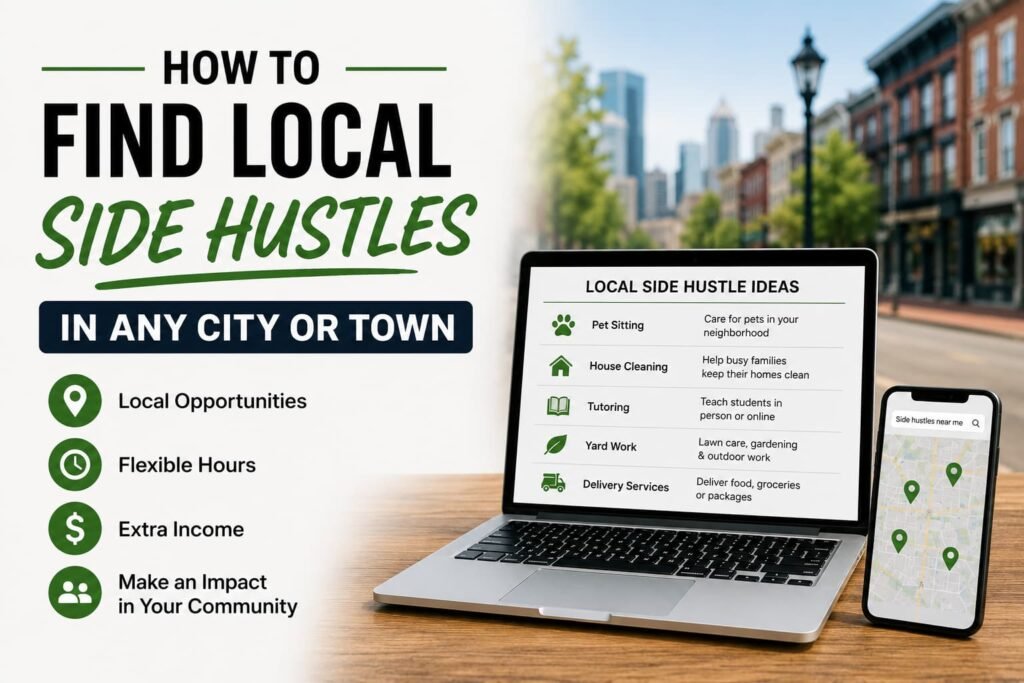

The best local side hustle for any particular person is almost never on a list. It depends on their street, their skills, the hours they keep, and what the people around them happen to need that week. A list cannot know any of that. It can only offer the options that are common enough to write about — which means the options everyone in town has already read about too.
This is the quiet problem with most side hustle advice. It is written for a generic place that does not exist. The reader lives in a specific city or town, with its own gaps and rhythms. The genuinely good opportunity is usually sitting in plain view — unwritten, uncrowded, and obvious only to someone who has learned how to look. This article is not another list. It is a way of seeing your own town as a place full of small, findable opportunities, and a set of methods for spotting the ones that fit you.
Every Place Runs on Unmet Needs and Idle Assets
Start with the principle, because the methods only make sense once it is clear. Every inhabited place — from a major city to a small town — has two permanent features that create local side hustle opportunities. The first is unmet needs: things people want done that no one is conveniently doing for them. The second is idle assets: useful things that sit unused most of the time, owned by people who would happily let them earn.
Unmet needs are everywhere once you start noticing them. The elderly neighbour who can no longer manage their garden. The two-income family with no time to assemble the furniture they keep ordering. The small shop owner who needs an online presence but has no idea how to build one. The dog owners on your street who feel guilty leaving their pets alone all day. None of these people are served by an app. They have a need, a little money, and no obvious person to hand it to. That gap is the opportunity.
What Idle Assets Look Like in Practice
Idle assets follow the same logic in reverse. A truck that sits in a driveway six days a week. A spare room, a garage, a driveway near a busy area, a set of power tools used twice a year, a camera that comes out only on holidays. Each of these is value sitting still. The owner thinks of it as something they bought. Reframed, it is something that could earn while they are not using it. The skill is learning to see what your town needs and what it is sitting on — and noticing where you can stand in the middle.
Learn to See Your Town as Source Material
The first method is the simplest and the one most people skip: pay deliberate attention to the place you already move through every day. Most of us travel through our own town on autopilot, registering almost nothing. The person looking for local side hustles moves through it with a different question running in the background — what here is missing, overpriced, slow, or annoying, and could I be the one who fixes it?
Walk your high street or main road and notice what is not there. A town with three coffee shops but nowhere to get a bike repaired is telling you something. Notice what has a queue and what has a waiting list — a barber booked three weeks out, a tradesperson who never answers because they have too much work. These signal demand that exceeds supply. That is where money waits. Also notice the handwritten signs in shop windows and on community boards. They are unfiltered requests from real people: someone wanting lessons, someone needing help moving, someone looking for a cleaner. Each one is a small market revealing itself.
Pay attention to the complaints you hear, including your own. People narrate their unmet needs constantly without realising it. The colleague who cannot find a reliable babysitter. The friend who hates assembling flat-pack furniture. The relative who would pay anything to have someone set up their new phone. A complaint is a need spoken aloud. The habit worth building is hearing complaints not as conversation but as quiet market research.
Ask, Because People Will Tell You Directly
Observation finds the visible gaps. Asking finds the ones you would never spot alone. The second method is simply to talk to people, with genuine curiosity, about what they wish someone would do for them.
This works because almost no one else does it. Ask a few local business owners what part of their week they most wish they could hand off. You will hear the same few answers repeatedly — bookkeeping, social media, deliveries, cleaning, admin. Those repeated answers are a map of local demand. Ask parents at the school gate, neighbours, people in community groups, and the picture sharpens further. You are not pitching anything yet. You are collecting honest information about what your specific community would pay to have solved. That is worth more than any generic list of trending local side hustles.
Local community spaces online have made this easier than ever. Neighbourhood groups, local social media pages, community forums and message boards are full of people asking for recommendations and help. Every unanswered or poorly answered request is a gap. When you see the same kind of request appear again and again — looking for someone who does this, anyone know a good that — you are watching demand announce itself in real time. The person who notices the pattern and quietly becomes the answer has found a local side hustle that no article could have handed them.
Follow the Money That Already Moves Locally
The third method is to notice where money already flows in your town. Established money flows reveal both proven demand and the gaps around their edges. You are not trying to invent a need. You are positioning yourself near spending that is already happening.
Look at what your town clearly spends on. A place full of young families spends on childcare, tutoring, kids’ activities, and anything that buys parents time. A town with an ageing population spends on help with homes, gardens, technology, and mobility. A commuter town empties during the day and fills in the evening. That shapes when people need things and when they will pay for convenience. A tourist town has a season, and that season has needs: parking, cleaning between guests, local guidance, equipment hire. Reading who lives in your town and how they spend tells you which local side hustles have a real market. You know this before you invest a single hour.
The Edges Are Where the Opportunity Sits
Then look at the edges of that spending. Where a big established business serves a need clumsily or impersonally, there is room for someone local and responsive. They can take the work the big provider does badly. Where a service exists only in the next town over, there is room to bring it closer. Where something is sold but not installed, fixed, cleaned or maintained, there is room in the gap. Established money flows are not competition to fear. They are confirmation of demand, with unserved edges that a small local operator can occupy.
The opportunity you are looking for usually sits where three things overlap: something your town needs, something you can actually do or provide, and something no one nearby is doing well yet. Any one of those alone is not enough. A need no one can serve is just a frustration. A skill no one needs is just a hobby. The local side hustle lives in the overlap — and the methods in this article are all ways of finding where, for you specifically, that overlap is.
Test Small Before You Believe It
Finding a possible opportunity is not the same as confirming a real one. The final method is to test cheaply before committing. The town will tell you quickly whether you have found something real. Offer the service to one or two people and see whether they say yes and — more importantly — whether they pay and come back. Post the idea in a local group and watch whether anyone responds. Put up the handwritten sign yourself and see whether the phone rings.
This matters because it costs almost nothing and protects you from the most common mistake — investing time and money into something that felt like a good idea but had no real local demand behind it. A genuine opportunity produces early signs of life almost immediately: people respond, ask questions, refer a friend. A false one produces silence. Reading those early signals honestly is what turns a hunch about your town into a local side hustle that actually works in it.
The Town Was Always Full of Opportunities
There is no list that can tell you the best local side hustles. The answer is assembled from things no list can see: the particular street you live on, the particular skills you carry, and the particular needs of the particular people around you. What can be taught is the way of looking — treating your own town as source material, hearing complaints as research, asking people directly, following the money that already moves, and testing small before you trust it.
Do that for a few weeks and the town you have walked through on autopilot for years starts to look different. The gaps become visible. The idle assets become obvious. The repeated requests in the local group stop being noise and start being a map. The opportunity was always there. The only thing that changes is that you have learned how to see it.
For country-specific guidance, the articles on best side hustles in the USA, best UK side hustles for people with a full-time job, and best side hustles in South Africa each cover the local landscape in their market in detail. And for a complete map of passive income options that can run alongside any local side hustle, the guide on passive income for 9-5 workers covers every stream worth considering.