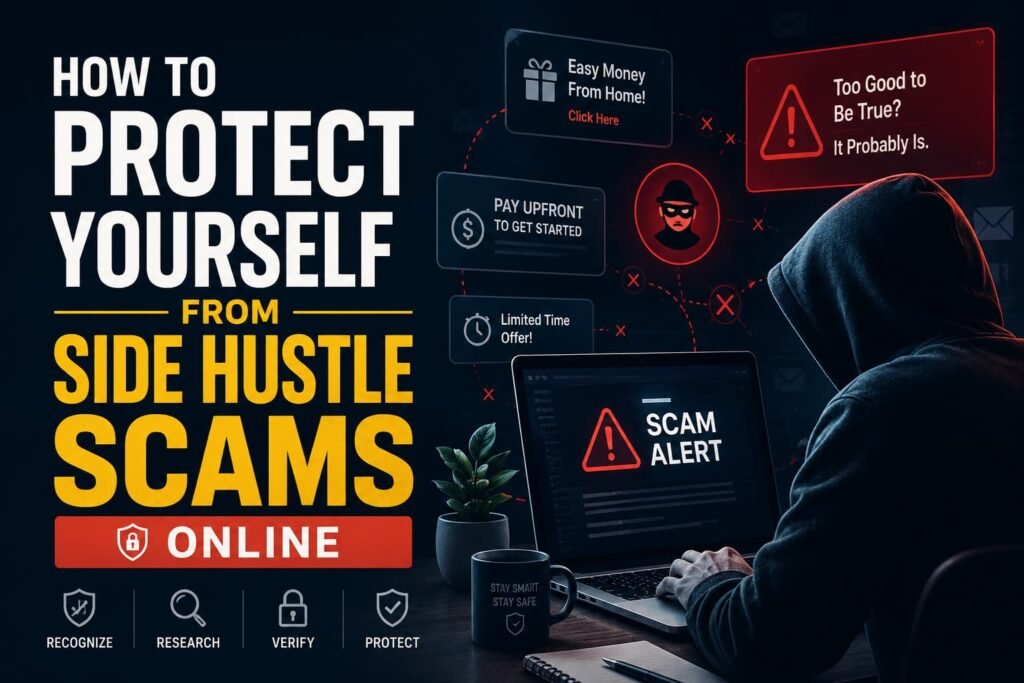

There is one question that exposes the large majority of side hustle scams, and it is worth learning before anything else: which way is the money flowing? In legitimate work, money flows toward you. You do something of value and you get paid. In a scam, at some point money or sensitive information has to flow away from you first. A fee to start, a deposit to unlock your earnings, a payment for training or equipment, your bank details before you have done anything. Whenever you are asked to send money or hand over sensitive data to begin earning, the arrow is pointing the wrong way. That single observation catches most scams regardless of how they are dressed up.
This matters more now than it used to, because the schemes look more convincing than ever. Scammers use AI to build polished fake company profiles, write flawless messages, and even fake recruiters on video. Reported losses from job and side hustle scams have climbed into the hundreds of millions as a result. But here is the reassuring part: the polish has changed while the tells have not. The newest, most sophisticated 2026 scam still fails the same basic tests the crude ones did years ago. Learn the tests, and you are protected against the scams that do not even exist yet.
The One Rule: Real Work Never Charges You to Start
Anchor everything on this, because it is the most reliable single rule there is: no legitimate job or side hustle requires you to pay money upfront to begin. Not for training, not for a starter kit, not for software, not for a background check, not to unlock your account or your earnings. The moment an opportunity asks you to pay to work, it is a scam, with effectively no exceptions worth risking your money on.
This rule cuts through an enormous range of schemes at once. The data-entry job that needs you to buy a training package first. The reshipping or product-testing role that requires a deposit for equipment. The platform that lets you complete tasks and watch small earnings accumulate, then demands a payment to release them. All of them rely on you accepting that spending a little now unlocks more later. It never does. The fee goes to the scammer and the earnings never arrive. If you internalise nothing else, internalise that legitimate work pays you, and you never pay it for the privilege of being paid.
Apply the money-flow test to anything that tempts you: at any point in this, am I being asked to send money, buy something, or hand over my bank or identity details before I have earned anything? If yes, stop. Real employers and platforms pay you after you work; they do not collect from you before. This one test, applied calmly before you act, prevents the majority of side hustle scams without your needing to recognise the specific trick being used.
The Scams Circulating Right Now
The underlying tricks are old, but it helps to recognise the specific forms they take in 2026. Seeing the pattern named makes it easier to spot in the moment.
Task Scams
Task scams are currently the most common, having grown from almost nothing a few years ago to a huge share of reported job scams. They work like this: you are offered easy, repetitive online work — rating products, liking videos, boosting apps, processing simple entries — often through an unsolicited text or a WhatsApp or Telegram message. At first it seems real. You complete tasks and see small payouts accumulate in an account. Then comes the catch: to unlock a bigger batch of commission, you must deposit your own money. The deposit goes to the scammer, the platform vanishes, and any banking or wallet details you shared go with it. The accumulating-balance illusion is the hook, and the deposit demand is the tell.
AI-Powered Job Scams and Other Variants
AI-powered job scams are the fastest-growing category. Scammers now generate convincing fake company websites, recruiter profiles and offer letters, and even deepfaked video interviews. As a result, the old advice to simply judge by how professional something looks no longer holds. Overpayment scams persist too: someone sends you a check or payment for more than agreed and asks you to refund the difference. The original payment later bounces, and you are out the money you sent back. Recruitment-style schemes that require you to recruit others or buy inventory to earn are multi-level marketing dressed as a side hustle, not employment.
A particular danger sign in 2026: being pushed off a legitimate platform onto WhatsApp, Telegram or personal text early in the conversation. Real recruiters and real freelance platforms keep the process on official channels, partly because those channels protect you. Scammers move you to private messaging precisely to escape that protection. An unsolicited offer that arrives by text and immediately steers you to a messaging app is following the standard scam script, however polished the messages themselves are.
The Red Flags, Beyond the Money Test
The money-flow rule catches most side hustle scams, but a few additional red flags help you spot the rest early, before any money is even discussed.
- Unsolicited contact offering a job out of the blue. Real opportunities rarely arrive as a surprise text or message offering you work you never applied for, especially with no real application process.
- Pay that is too high for the work. Promises of large, easy money for simple, unskilled tasks — generous hourly rates for typing or rating products — are a core lure, because the unrealistic reward is what overrides caution.
- An instant offer with no real process. Even a casual side gig involves some genuine back-and-forth. A job offered in the first message, with no interview or verification, is following a script.
- Requests for sensitive details too early. Being asked for your bank account, Social Security or national ID number, or copies of identity documents before you are genuinely hired is a way to steal your identity, not onboard you.
- Payment demanded or offered in unusual forms. Gift cards, wire transfers and cryptocurrency are favoured by scammers because they are hard to trace and reverse. Any of these in the picture is a strong warning.
- Vagueness about the actual work or how you get paid. A real role can explain clearly what you will do and how and when you will be paid. Persistent vagueness usually means there is no real job behind it.
The Habits That Keep You Safe
Recognising red flags is most of the protection. A few simple habits handle the rest and cost almost nothing to adopt.
Research, Verify and Slow Down
Search the company or person’s name alongside words like scam, complaint and review, and see what others have reported. A few minutes here exposes most known schemes. Verify independently rather than trusting the contact’s own links: if a message claims to be from a real company, go to that company’s official website directly and confirm the role and the recruiter exist. Do not click anything in the message itself.
Slow down when you feel urgency. Pressure to act immediately — a deadline, a limited number of spots, a now-or-never tone — is a deliberate tactic to stop you thinking. Almost nothing legitimate genuinely requires an instant decision. And talk to someone you trust before committing to an unexpected opportunity. Simply describing it aloud to another person often surfaces the problem you were too hopeful to see.
Protect your information the way you protect money. Keep your banking details, identity documents and personal data back until you have independently verified that an employer is real and you are genuinely hired through a legitimate process. A real employer collecting tax or payment details does so through proper, verifiable channels after hiring you — never through a chat app from someone who contacted you out of the blue. When in doubt, sharing nothing costs you nothing; sharing too soon can cost you a great deal.
If You Think You Have Been Targeted
If something has crossed the line from suspicious to harmful — you have sent money, shared banking or identity details, or realised after the fact that an opportunity was a scam — act quickly rather than out of embarrassment. Stop all contact with the scammer immediately. If you shared bank or card details, contact your bank or card provider straight away, as fast action can sometimes stop or reverse a payment. If you shared identity information, take steps to protect your accounts and consider monitoring or freezing your credit where that is available to you.
Then report it. Reporting helps authorities track and disrupt these schemes and can warn others. Most countries have a fraud-reporting body for exactly this. In the United States the Federal Trade Commission takes reports at its fraud reporting site, and other countries have their own equivalents you can find by searching your country’s name with the phrase report fraud. Being scammed is not a personal failing. These operations are professional, well-resourced and designed to fool careful people. The useful response is not shame but speed and reporting.
The Seam That Never Closes
Side hustle scams will keep evolving, and the next wave will look more convincing than this one — better fakes, smoother messages, more believable recruiters. Chasing each new variant is a losing game. What does not change is the underlying shape: every one of these schemes, however sophisticated, eventually needs money or sensitive information to flow from you to them before you have earned anything. That is the seam that never closes, because it is the whole point of the scam.
So you do not need to recognise every trick. You need to hold onto the one question that exposes them all — which way is the money flowing — and the discipline to stop and verify when the answer points the wrong way. Real work pays you. Anything that asks you to pay it first, in money or in trust, has told you what it is, no matter how good it looks.
For legitimate platforms where the money genuinely flows toward you, the guide on how to get your first client on Fiverr and the article on making money on Upwork without quitting your job cover how both platforms actually work. For those looking closer to home, the guide on how to find local side hustles in any city or town covers options that rely on local reputation rather than anonymous online platforms. And for setting any legitimate hustle up with the right free tools from the start, the article on best free tools every side hustler needs covers what actually saves time and money.