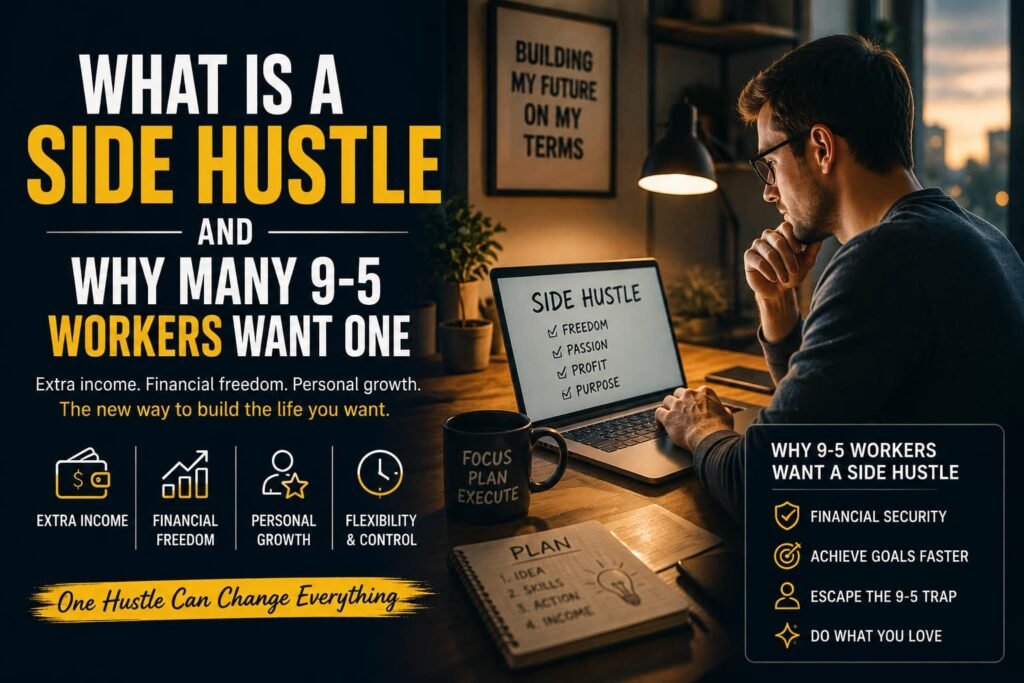

A side hustle is not a second job, and that difference is the whole point of it. A second job is more of the same arrangement you already have: someone else’s schedule, someone else’s rules, traded hours for a fixed wage. A side hustle is something you own and control. It is work you choose, on your own terms, in the hours you decide. It earns money independently of your employer. You might do both for the income, but only one of them is yours. That distinction is what makes a side hustle worth understanding properly before starting one.
In plain terms, a side hustle is a way of earning income outside your main job — freelancing, selling products, creating content, offering a local service, building something that pays you over time. What sets it apart is ownership and flexibility: you decide what it is, how much of it you do, and when. For someone with a full-time job, that combination is precisely the appeal. It means an extra income stream that fits around the work you already have rather than replacing one boss with two. This article explains what a side hustle actually is, the honest reasons people want one, and the honest reasons some people are right not to bother. It also covers how to think about starting, with links to the deeper guides on each path throughout this blog.
Side Hustle, Second Job, Hobby: What’s the Difference?
The term gets used loosely, so it helps to draw the lines clearly. Which one you are actually doing changes how you should approach it.
A second job is employment. You work set hours for an employer who pays you a wage and controls the work. It is a reliable way to earn more, but it carries none of the ownership or flexibility that defines a side hustle. It also stacks someone else’s schedule on top of your existing one. A hobby is something you do for enjoyment that may cost money rather than make it. The moment you deliberately turn it toward earning, it starts becoming a side hustle. A side hustle sits between them. It is more flexible and self-directed than a second job, and more intentional about income than a hobby. The defining features are that you own it, you control it, and it is built to earn.
This matters because people often start what they call a side hustle but run it like a second job. They take on so much rigid, time-for-money work that they end up with a second employer’s worth of obligation, minus the ownership. The whole advantage of a side hustle is the control it gives you over how, when and how much you work. Keeping that control is part of doing it well.
The Honest Reasons People Want One
Side hustles are common. By careful estimates, somewhere around a quarter to a third of workers in countries like the US and UK have one at any given time. The share is higher among younger workers. However, the reason people want them is more varied and more interesting than the hype suggests. Being honest about the range matters.
The most cited reason is simply more money, and what that money is for differs enormously. For some it genuinely covers essentials and closes a gap between wages and rising costs. This is a real and pressing motivation for many. But notably, the majority of side hustlers are not doing it out of desperation. Surveys consistently find that most pursue a side hustle for reasons beyond just making ends meet. These include discretionary income for the things a salary does not stretch to, savings, paying down debt faster, or simply the security of a second stream that does not depend on one employer.
Beyond money, the reasons people actually report are telling. Many want the flexibility and the sense of control over their own work that a job does not give them. A large share are pursuing a skill or a dream. They are building toward something they would rather be doing, on a small scale and at low risk, while a steady salary covers the bills. Others want to learn, to test a business idea without quitting anything, or to create something that is theirs. The honest picture is not a workforce desperately bailing water. It is a mix of people closing real gaps and people building something they want, and both are legitimate.
The most useful way to frame the appeal: a side hustle lets you pursue extra income, a new skill, or a business idea, without betting your financial security on it. The salary keeps the lights on and removes the desperation that makes people take bad decisions. The side hustle is where you build something extra, at your own pace, with a safety net underneath. That low-risk quality — earning or building on the side of stability rather than instead of it — is the genuine reason it suits a 9-5 worker so well.
And the Honest Reasons Not to Have One
Here is the part most articles on this topic leave out: not everyone needs or should have a side hustle. Pretending otherwise does readers a disservice. A side hustle costs time and energy you currently spend on other things — rest, family, your main career, your health — and for some people that trade is not worth making.
The single most common reason people do not have a side hustle is a straightforward lack of time. That is often a sensible answer rather than a failure of ambition. If your full-time job is demanding and you are already stretched, a side hustle can cost more in exhaustion and strained relationships than it returns in income. If you are financially comfortable and value your free time, you are allowed to simply enjoy it. Your energy might also be better invested in advancing your main career, where a promotion could raise your income far more than a side hustle would. A side hustle is a tool, not an obligation, and choosing not to use it is a perfectly rational decision for plenty of people.
The point of being clear about this is that a side hustle works best when it is a genuine choice made for a real reason, not something taken on out of guilt or hustle-culture pressure. If you want one — for the money, the skill, the security, or the thing you are building toward — the rest of this blog is here to help you do it well. If you have weighed it honestly and the answer is no, that is a legitimate answer too.
The Main Kinds of Side Hustle
If you do want one, the next question is what kind. Side hustles fall into a few broad families, each suiting different people and goals. This blog covers each in depth. Here is the map.
Freelancing and Services
Freelancing and services means selling a skill — writing, design, development, consulting, virtual assistance — to clients, often through platforms. It is the fastest route to real income if you have a marketable skill. For a practical starting point, the guide on Fiverr for beginners covers the cold-start problem in detail. For the premium end of the market, the article on freelancing on Toptal covers the screening process and what it takes to get in.
Selling Digital Products
Selling products, especially digital ones, means creating something once and selling it repeatedly. Templates, printables, ebooks and courses are common examples, sold through marketplaces or your own storefront. The guide on the Etsy side hustle covers opening a shop and actually selling. The article on best digital products to create once and sell forever covers which products are worth building.
Local and In-Person Side Hustles
Local and in-person side hustles serve demand in your own area — tasks, tutoring, delivery, services. The guide on how to find local side hustles in any city or town covers finding these wherever you are. Country-specific guides on this blog include side hustles in India and side hustles in South Africa.
Content and Audience-Based Hustles
Content and audience-based hustles build something that earns over time — a blog, a YouTube channel, a paid newsletter — through ad revenue, sponsorship, subscriptions or products. These are the slowest to pay but can become genuinely passive. The guide on how to earn from a blog without posting every day covers the long timelines involved honestly.
If you are not sure which family fits you, a simple rule helps. If you have a skill and want income soonest, start with freelancing. If you want something that eventually earns without your constant time, start with digital products or content. If you want fast, flexible local income, look at in-person options. The guide on passive income for 9-5 workers walks through every option worth considering. The toolkit pieces on this blog cover the free tools, income tracking and scam-awareness that apply whichever path you choose.
How to Actually Start
The biggest mistake beginners make is over-preparing: researching endlessly, assembling tools, planning a perfect launch, instead of starting small and learning by doing. A side hustle is built by beginning, not by getting ready to begin.
Pick one path that fits your skills, your time and your reason for wanting it. Take the first real step this week rather than next month. Use what you already have rather than buying anything. Keep it small enough to fit your actual free hours, and treat the first weeks as learning rather than earning. Set up the basics honestly from the start: a way to track the income for tax, and an awareness of how to spot the scams that target beginners. Otherwise, resist the urge to perfect before you launch. For a practical look at the tools worth having from day one, the article on best free tools every side hustler needs covers what to set up and what to skip. The detailed guides on this blog cover each path step by step. The one thing none of them can do for you is the starting — the only part that actually matters at the beginning.
Income You Own, Built on the Side of Stability
A side hustle, stripped of the hype around it, is simply income you own and control, built on the side of a job that keeps you stable. That is the whole idea, and it is a genuinely good one for a great many people. It suits those who want extra money without extra risk, a skill or a business built at their own pace, or the quiet security of not depending on a single employer. The reasons are varied and mostly positive, and the barrier to starting has never been lower.
But it is a choice, not a duty. The honest version of this topic is that many 9-5 workers want a side hustle for good reasons, some need one, and some are entirely right to skip it. If you are in the first two groups, everything else on this blog exists to help you choose a path and start it well. Knowing what a side hustle actually is, and being honest with yourself about why you want one, is the right first step either way. The guide on how long it takes to build passive income gives a realistic, honest timeline for each stream.